Showing posts sorted by relevance for query Downtown Nashville's Small Urban Spaces. Sort by date Show all posts

Monday, March 27, 2006

Downtown Nashville's Small Public Spaces: 333 Commerce at the Batman Building, Part I

In the third installment of my series on Downtown's small public spaces (the first is here; the second is here) based on the film, "The Social Life Of Small Urban Spaces," I take a look at what has to be one of the more attractive spaces for people to gather: the plaza at the foot of the "Batman Building." Also known as the "BellSouth Building," 333 Commerce is one of the most popular Nashville landmarks, so it is fitting that one of the more attractive public spaces can be found at its base. The small public space is actually relatively large, occupying both the northwest corner of the property and the southeast side of the building along 3rd Avenue. Because of the considerable size and many features of the public space at 333 Commerce, I am looking at it in two parts. Overall, 333 Commerce has nearly all of the attractors identified in the film on small public spaces.

The northwest corner of the property is bathed in natural sunlight, and it is punctuated by a public art feature. The space has a variety of plants and trees accentuating long grassy lawns. A number of benches, low walls, and steps offer pedestrians places to sit, and along with the flora provide lots of "edges" where people can go and get some sense of out-of-the-way seclusion. The day I was there I saw no food vendors, but there is a large paved a walkway that runs from the corner plaza entrance to the BellSouth Building that could accommodate some food carts. There seems to be room on the lawns for a small number of café-like tables, although too many spread around the lawn might give the plaza a cluttered look. However, there is plenty of seating without tables so that people could tarry here for lunch if there was food readily available.
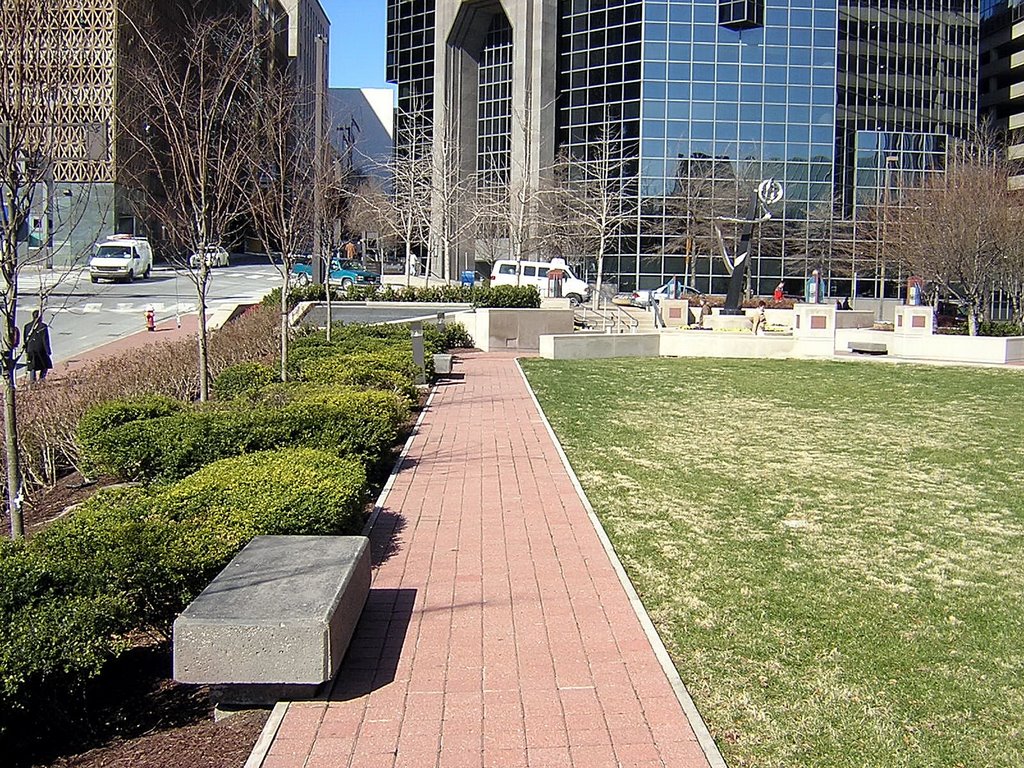
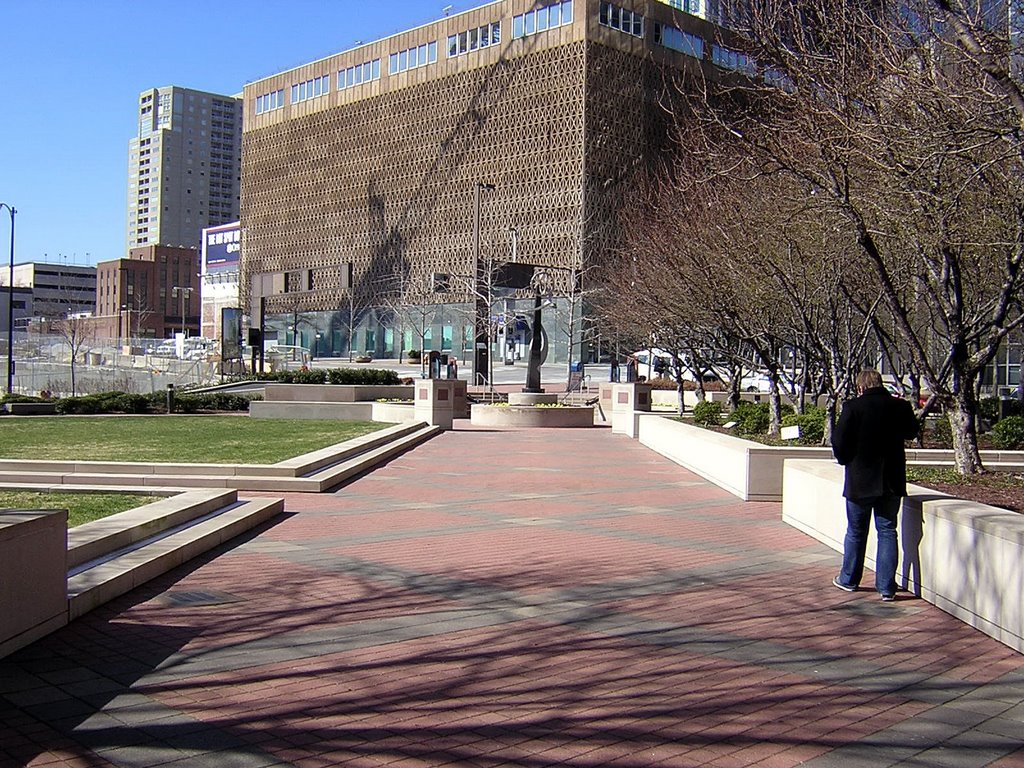
The aspects of this plaza that might hamper its attractiveness generally involve street accessibility, which is limited. The plaza is ringed by low walls and hedges with a small number of entry points. Save for the corner of Commerce and 4th, the plaza has the feel of being closed off from the street, which may or may not be a strong attractor for occupants of the Batman Building, but it would not seem to be a strong attractor for casual passers-by. The filmmakers said that one of the attractors of a space is in its allowance for people-watching. If the plaza is closed off from the street, it discourages people-watching. Another strike against this plaza is that seating is fixed and cannot be moved around to suit individuals or groups. They have to take what they can get. Finally, because the space is large-scale and without hidden interesting features (such as the sound of water flowing), I don't believe it would possess that mysterious aspect that makes pedestrians want to stop and explore the space.

Once you discover this space, it seems one of the more outstanding places to gather. However, you have to be intentional in order to find it. It is not easily stumbled upon.

Monday, February 13, 2006

Downtown Nashville's Small Public Spaces: Church St. At The Library

My viewing of the film on small urban public spaces last week motivated me to scout around Downtown to survey the public spaces there. I started with the small park at the corner of Church St. and Capital Blvd. across from the Downtown Public Library, which was mentioned in the discussion after the film. There are a number of homeless people who stay in that park during the day, probably because they can use the public library computers to go online and their restrooms to relieve themselves. As mentioned at the showing, a relatively large number of homeless people in public spaces may be a deterrent to other visitors staying. While I was at the park, one of the homeless men proceeded into what looked like some martial arts techniques, high-kicking and various gyrations at the air in front of him. That could probably scare some folks off.

I took some pictures of characteristics of the park that were mentioned in the film:

The park opens invitingly to the sidewalk and it is only slightly obstructed from the street by small concrete and wrought iron planters with small trees in them. Since "people-watching" is one of the primary attractors of public spaces, the clear lines of sight in all directions should work in its favor.
It is also lit well by direct sunlight. According to the filmmakers, spaces do not have to be in absolute sunlight, but they should be well lit by at least indirect sunlight. In the distance you may be able to make out a crowd around a telephone booth and a large rectangular light fixture. I'll tell you more about what was going on there in my next post.
The film mentioned visible water features as strong attractors of people to public spaces. The sidewalks that run through the park converge at the fountain. Visitors to the park are in close contact with this fountain and the wall provides roomy seating. Public art is also considered an attractor; there is a mural on the wall of the building sitting flush to the park's edge (I didn't get a picture of that).
There are a lot of places to sit in this park, including retaining walls and benches, but no movable seating, which the film called a strong attractor. However, the seating provides various angles for people-watching, and there are "edges" that allow those who desire to "be away" from the crowd places to sit.

Overall, I would consider this public park fairly close to fitting what the filmmakers had in mind for optimum public space in a city. The scale is somewhat small, compared to some of the places in New York City the film looked at, but I got the impression that small scale is much better in the researchers' minds than oversizing a space.

Thursday, December 18, 2014

Are we close enough to Nashville's new ballpark to spot the manure?

Aaron Gordon at Vice Sports engages in a scathing open dialogue with a New York Times article regarding Washington, DC's plan to subsidize a new soccer stadium for its pro-team. While Gordon's entire piece is worthy of your time and attention, I wanted to comment on his observations about the lack of promised economic development that was to come with the opening six years ago of a new professional baseball park.

It seems relevant to North Nashville's close proximity to the new Nashville Sounds' home, First Tennessee Park, which is promised to bring dramatic economic development to the Jefferson Street corridor and the nearby neighborhoods. NYT comments are in bold; Gordon's replies are unbolded:

City leaders say the 20,000-seat stadium will serve as a catalyst for economic development for this area of southwest Washington, the way that Nationals Park, home of the Washington Nationals baseball team, did for its formerly stagnant neighborhood just a few blocks north and east.

Amazingly, the second half of this sentence directly contradicts the first. It takes 12 minutes to walk from Nationals Park to the very tip of Buzzard Point. If Nationals Park—which cost $700 million of taxpayer money—was such a catalyst for economic development, why do they need to build another nine-figure stadium a few blocks away?

Maybe because it didn't revitalize anything.

This has been the case in other Washington neighborhoods after the city voted to approve major new public venues...

Oh, cool! I mean, if it's worked before...

...including the Verizon Center, home to the N.B.A.'s Wizards and the N.H.L.'s Capitals since 1997;...

That was privately funded by then-owner Abe Polin, so not really a public investment! OK, what else?

...and the 2.3 million-square-foot Walter E. Washington Convention Center, completed in 2003, in revitalized Mount Vernon Square.

Wait, seriously?

I lived in the DC area for eight years, including a year and a half in Shaw, which lies just north of Mount Vernon. The above sentiment about Mount Vernon being "revitalized" is the kind of buried horseshit you can only spot if you're close enough to smell it.

Granted, the cost of the DC baseball stadium in taxpayer money was about 10 times what First Tennessee Park is going to cost Nashvillians in taxes. The flip side of that: the logic unfolds that the economic development in DC communities should proportionately be 10 times what was promised for North Nashville neighborhoods.

However, nearby DC neighborhoods got zilch.

Let's focus on the DC developer's comment that local lawmakers may have rigged expectations too high in order to give the ballpark project momentum. Some of us have been shouting that from jump with Nashville's ballpark. But to the point: they rationalized after the damage was done by minimizing the impact of the new ballpark, saying it is "just a very small piece" of development in the neighborhoods. Will First Tennessee ballpark developers and team owners thusly walk back their spin in the coming years? Will they be minimizing the claims Hizzoner kept making in late 2013 about how a new ballpark will create Jeff St. "revival"?

(If they're honest, they'll acknowledge that our neighborhoods were developing and gentrifying well before a new ballpark rose to the level of anything above a nostalgic pipe dream).

Like DC, Nashville has a convention center that is not performing to the results promised. Nashville is getting half the projected hotel nights, and no doubt tourists will compete for parking spaces downtown with minor league baseball fans for parking spaces during the summer (Metro officials said they hope Sounds fans use shrinking downtown parking opportunities). When they aren't competing downtown they will be choking on-street parking in Germantown, Hope Gardens and Salemtown.

The logic of overrated convention centers also applies to subsidized ballparks:

The whole process is basically maneuvered by the business community — banks, hotels, retailers, construction industries, others who will profit while the city loses .... Cities’ corporate movers and shakers long ago figured out how to get their new centers or expansions without the voters having a say.

The rising $70,000,000 Nashville is giving minor league team owner Frank Ward does one thing above all: it minimizes his family's risk and it maximizes inflated income from ticket and merchandising sales. It does so at our expense, even though our own elected officials allowed practically no influence over the deal. In particular it allows Mr. Ward to sell luxury boxes to rich people from Brentwood and Williamson County who would be more likely to snap up real estate investments in our urban core neighborhoods than to patronize and to put their cash in the pockets of the locally owned businesses up and down Jefferson Street.


Again, regular make-ends-meet taxpayers are the losers in this scenario, because economic benefits pad the pocketbooks of the people privately invested in the ballpark and other nearby properties. The latter need no financial assistance. Little will come back to us regardless of whether this particular ballpark bucks the trend and the science that indicate that any economic impact of sports venues is negligible and fabricated.

I am still waiting for someone to stop cheerleading and to begin explaining to me logically how the ballpark makes our lives cumulatively better in Salemtown when the costs are frankly and fearlessly considered.