Showing posts with label Small Urban Spaces. Show all posts

Sunday, July 13, 2008

They Say the Future of Bikes is Bright on Broadway

NYC is eliminating two lanes of traffic on the world's most famed and traffic-congested boulevard in order to make it more bike-and pedestrian-friendly:
[The Bloomberg Administration is] spending $700,000 to create the string of blocklong plazas from 42nd to 35th Streets. That includes painting the bike lane green, buying the chairs, tables, benches, umbrellas and planters and applying a coat of small-grained gravel mixed with epoxy onto the pedestrian areas, which will set them off from both the street and the bicycle path.
Three private improvement districts will spend $280,000 per year on maintenance of the plazas.

Contrast NYC to post-Purcell Nashville where recently the wide major artery heading north out of Downtown was repaved and repainted by TDOT without any consideration of installing a bike lane.

Sunday, July 06, 2008

"Small Urban Spaces" Doc Now on YouTube

A couple of years ago I attended a Nashville Civic Design Center screening of "The Social Life of Small Urban Spaces," a documentary identifying qualities of the built environment that draw people to linger and socialize. I also wrote a series of articles on Nashville's small urban spaces--some of which can be read here--based on my viewing.

If you haven't seen that documentary, yet, I highly recommend it, and fortunately, it has been posted on YouTube:


HT: bzorch


UPDATE: The video has been removed from YouTube. There is a fragment of it currently posted at Vimeo:

Wednesday, July 05, 2006

Downtown Nashville's Small Public Spaces: Courthouse Square Construction Pictures

As part of Enclave's on-going series of small public spaces in Downtown Nashville (past articles here and here and here and here), I am posting pictures of the construction of the Public Square in front of the Courthouse, itself undergoing renovation. The first picture was taken by Nashville Charrette administrator, bzorch, and posted on the Charrette over the weekend. I took the rest of the photos myself a few weeks ago.

You should be able to see from the pictures that this square will be one of the prominent public spaces in Downtown once it is finished. As such it will suit the need that Downtown has for more public green space for lunching and otherwise chilling out. While unfinished, it seems that it is going to possess a number of the qualities that small public spaces have, including direct or indirect sunlight, lots of places to sit (both conventional benches and scores of stairs for impromptu seating), open entry to and from the surrounding streets and sidewalks for people-watching, and steel tables and chairs (located at the top of the distant stairs in the third picture; although they do not look like they can be moved, which would have been another strong attractor). Currently, the square is wide-open and it is hard to tell without all of the foliage in whether there will be "edges" that allow a place for those who prefer to be away from the crowd.


Tuesday, March 28, 2006

Downtown Nashville's Small Public Spaces: 333 Commerce at the Batman Building, Part II

This is the second part of my look at the 333 Commerce Plaza, which sits on either side of the Batman Building. I explored the northwest corner of the plaza in Part I, finding many attractive features and few drawbacks. In this post I focus on the southeast side. Most of the attractors that the northwest space lacks are compensated by features on the other side of the building, which contains a vastly different space.

There are two significant attractors on the southeast side that pedestrians will not find elsewhere on the plaza. One is a large, audible, and long water feature that accentuates the main walkway and staircase to the building. In my opinion, except for the fountains at Bicentennial Mall, this is the most attractive water feature of any downtown public space. It starts as a tall, graduated waterfall framed by faux rock outcroppings and various types of plants. The waterfall pools at various places and becomes a stream that actually runs under one of the walkways into a larger pool with a smaller waterfall feature. The second waterfall feature provides the edge to one of the tiered patios. That particular patio has precast cement tables and chairs that seem well-suited to having a meal. Within the plaza itself, there is so much water moving around that the sounds are distinct and interesting.

There is a second patio with seating amenities above the tall waterfall feature and off to the side of the main entrance to the building. The tables and chairs on the higher patio are metal mesh, and the chairs have backs. That patio seems to lead off of an indoor café within the 333 Commerce Building. So, food and a place to park yourself to eat seem readily available in the southeast plaza. That patio also has a picturesque view to the south of the Schermerhorn Symphony Center (currently under construction). Most of the tables and chairs on this patio are bolted down, but I did see two or three free-standing chairs. Chairs that can be moved to accommodate individual tastes are a strong attractor to public spaces.

Like the northwest corner, the southeast side seems well lit by sunlight (both direct and indirect; that is considered a strong attractor), but there are areas that sit close to the buildings fronting Broadway that are shaded. Also, consistent with the rest of the property, the southeast side has numerous partially-hidden edges that encourage out-of-the-way people-watching. And like the northwest corner, this plaza has a lot of plants and trees to attract pedestrians. Unlike the flatter northwest corner, this side is more tiered, which is visually interesting, but leads to what I consider to be a significant flaw with regard to pedestrian traffic.

The lowest tier of this plaza looks to be about 2 stories off of street level. That effectively closes it off to the street. There is nothing interesting or attractive about the cold cement wall and two flights of stairs that act as the street level entrance to the plaza. The street is so far down that, when I was there, I could not even hear the water sounds that were so prominent in the plaza itself. When I looked up the stairs I got no sense of mystery whatsoever that would cause me to break off a sidewalk stroll to explore what might be at the top. It just looked like a generic building entrance. Even the stairs are not an attractive place to kill time. They are tall, shallow, shaded, and cold. They might be a good place to stop and cool off after a jog on a hot day, but they are strictly utilitarian in function.

So, while the southeast side of 333 Commerce provided many attractors that the other side did not, it had some of the same flaws, especially in being closed off from street level. Only the intentional explorer and those who know of the plaza would be motivated to hike up the stairs in order to enjoy one of the more attractive small public spaces in Nashville.

Monday, March 27, 2006

Downtown Nashville's Small Public Spaces: 333 Commerce at the Batman Building, Part I

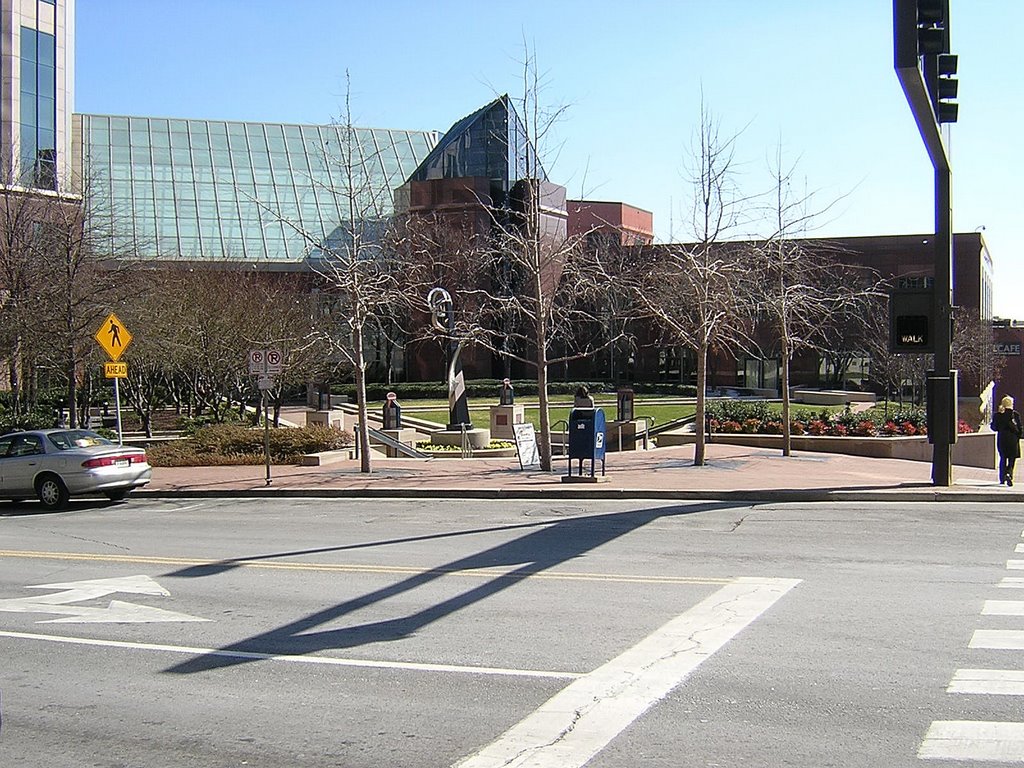
In the third installment of my series on Downtown's small public spaces (the first is here; the second is here) based on the film, "The Social Life Of Small Urban Spaces," I take a look at what has to be one of the more attractive spaces for people to gather: the plaza at the foot of the "Batman Building." Also known as the "BellSouth Building," 333 Commerce is one of the most popular Nashville landmarks, so it is fitting that one of the more attractive public spaces can be found at its base. The small public space is actually relatively large, occupying both the northwest corner of the property and the southeast side of the building along 3rd Avenue. Because of the considerable size and many features of the public space at 333 Commerce, I am looking at it in two parts. Overall, 333 Commerce has nearly all of the attractors identified in the film on small public spaces.

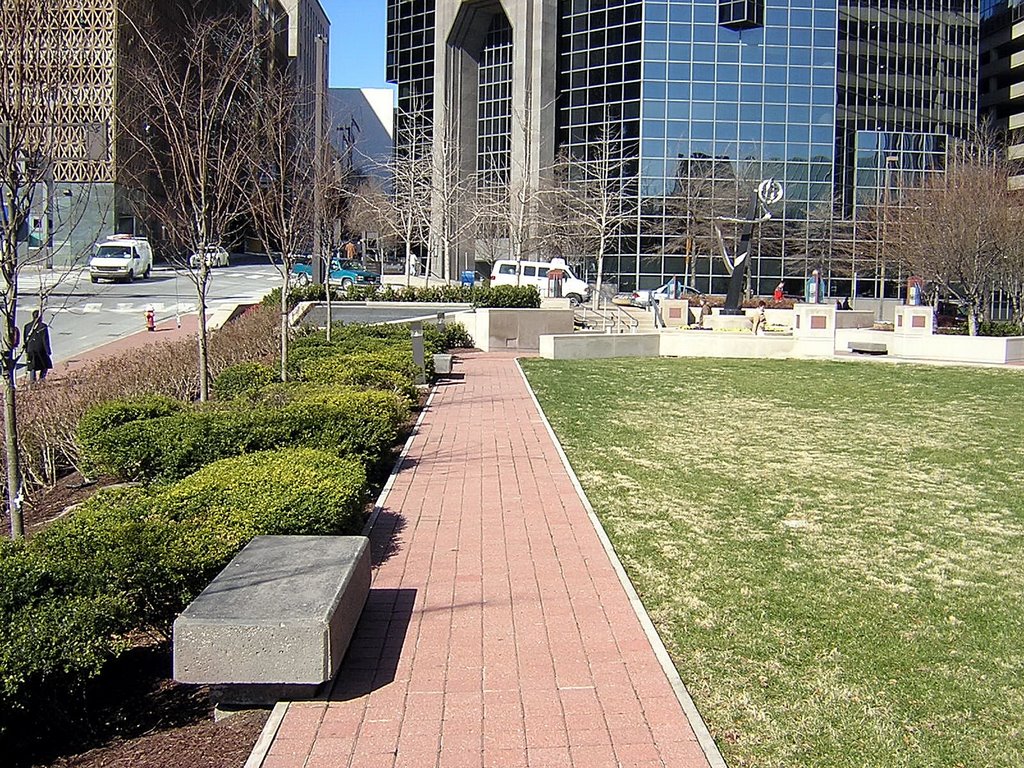
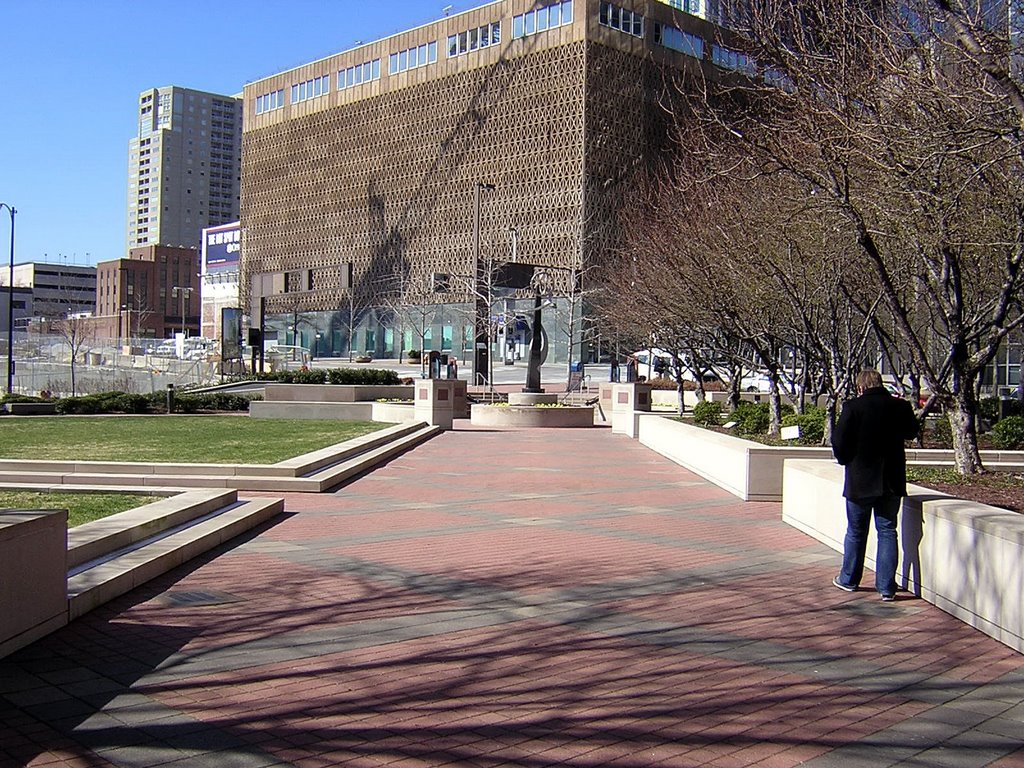
The northwest corner of the property is bathed in natural sunlight, and it is punctuated by a public art feature. The space has a variety of plants and trees accentuating long grassy lawns. A number of benches, low walls, and steps offer pedestrians places to sit, and along with the flora provide lots of "edges" where people can go and get some sense of out-of-the-way seclusion. The day I was there I saw no food vendors, but there is a large paved a walkway that runs from the corner plaza entrance to the BellSouth Building that could accommodate some food carts. There seems to be room on the lawns for a small number of café-like tables, although too many spread around the lawn might give the plaza a cluttered look. However, there is plenty of seating without tables so that people could tarry here for lunch if there was food readily available.

The aspects of this plaza that might hamper its attractiveness generally involve street accessibility, which is limited. The plaza is ringed by low walls and hedges with a small number of entry points. Save for the corner of Commerce and 4th, the plaza has the feel of being closed off from the street, which may or may not be a strong attractor for occupants of the Batman Building, but it would not seem to be a strong attractor for casual passers-by. The filmmakers said that one of the attractors of a space is in its allowance for people-watching. If the plaza is closed off from the street, it discourages people-watching. Another strike against this plaza is that seating is fixed and cannot be moved around to suit individuals or groups. They have to take what they can get. Finally, because the space is large-scale and without hidden interesting features (such as the sound of water flowing), I don't believe it would possess that mysterious aspect that makes pedestrians want to stop and explore the space.

Once you discover this space, it seems one of the more outstanding places to gather. However, you have to be intentional in order to find it. It is not easily stumbled upon.

Wednesday, March 08, 2006

Downtown Nashville's Small Public Spaces: Financial Center Plaza


This is the second installment of my survey on small public spaces in Downtown Nashville. The first was on the small park across the street from the Downtown library. I had originally intended to post this follow-up sooner, but Carrie Underwood, the Nashville City Paper, and other North End issues rose up for writing beforehand.

Let me turn your attention next to the Financial Center at the corner of Church St. and 5th Ave., North. Let me also add a caveat: when I refer to small public spaces, I am using a soft sense of "public" rather than a hard definition of "public." I am not only referring to parks that are publicly owned, but also those privately owned properties that get used in a public manner with little or no hampering of social gathering. This is an important distinction, not because more public ownership of property is unimportant, but because it is unrealistic to assume that publicly owned properties can dominate highly dense areas. I'm all for setting aside as much property for public ownership as is possible, but very often private squares and plazas have to pull double-duty, and they should do so. So, I refer to the Financial Center Plaza as a small public space in the softer sense of the term.

A large, bricked-over plaza fronts the Financial Center with a few trees, but very little other greenery. There is no water feature, which is one of those attractors mentioned in the film. The plaza is well-lit by both indirect and direct sun-light. There is no seating provided in the plaza (which would be considered another strong attractor), and it seems generally an area meant for crowds of people to move quickly through, north-to-south and east-to-west. It is totally open to the public sidewalk, but there is nothing about the plaza itself that would make people want to stop and look. It seems a utilitarian void designed for movement.

The few "edges" to the plaza are the only spaces where gathering could occur. Those edges do not fall on the west (street curb) or on the east (an alley). The north edge is the shaded and raised building portico. The steps of the portico could invite people to sit and talk or eat lunch, but I do not know whether they are so used. Right now, scaffolding obstructs access to those steps. I also do not know whether building security allows or encourages people to gather on the steps to socialize. Only the public sidewalk along Church St. (recently renovated) can be considered a strong public space. It contains planters and a few benches, for those willing to play "musical chairs" to get a seat.

Overall, I would say that this is a relatively weak small public space for Downtown residents and workers who seek to pause somewhere to people-watch. If people will be allowed to sit on the steps once the scaffolding comes down, I would move the plaza up to the "fair" category. Otherwise, seating is nearly non-existent. There is nothing remarkable or even remotely eye-catching about the Financial Center Plaza that would make people stop and take notice. I think that it could be vastly improved with a small outdoor cafe and food vendors. That would be a nice, sun-bathed option among the many restaurants that populate the Church St. area.

Monday, February 13, 2006

Downtown Nashville's Small Public Spaces: Church St. At The Library

My viewing of the film on small urban public spaces last week motivated me to scout around Downtown to survey the public spaces there. I started with the small park at the corner of Church St. and Capital Blvd. across from the Downtown Public Library, which was mentioned in the discussion after the film. There are a number of homeless people who stay in that park during the day, probably because they can use the public library computers to go online and their restrooms to relieve themselves. As mentioned at the showing, a relatively large number of homeless people in public spaces may be a deterrent to other visitors staying. While I was at the park, one of the homeless men proceeded into what looked like some martial arts techniques, high-kicking and various gyrations at the air in front of him. That could probably scare some folks off.

I took some pictures of characteristics of the park that were mentioned in the film:

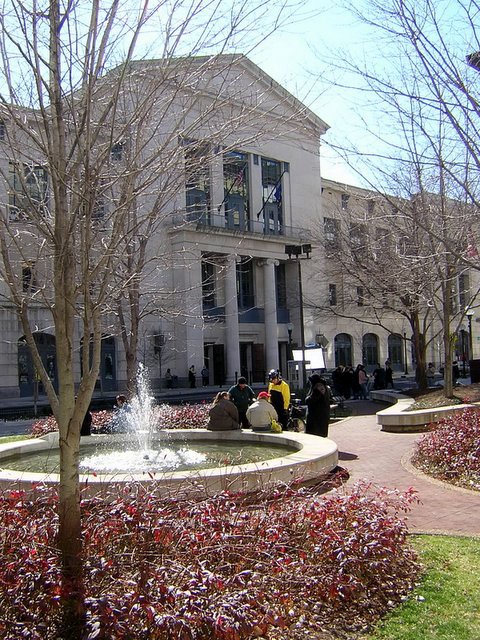
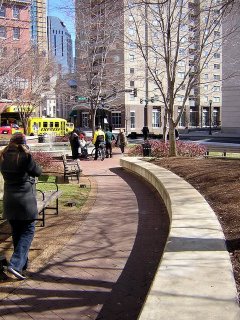
The park opens invitingly to the sidewalk and it is only slightly obstructed from the street by small concrete and wrought iron planters with small trees in them. Since "people-watching" is one of the primary attractors of public spaces, the clear lines of sight in all directions should work in its favor.
It is also lit well by direct sunlight. According to the filmmakers, spaces do not have to be in absolute sunlight, but they should be well lit by at least indirect sunlight. In the distance you may be able to make out a crowd around a telephone booth and a large rectangular light fixture. I'll tell you more about what was going on there in my next post.
The film mentioned visible water features as strong attractors of people to public spaces. The sidewalks that run through the park converge at the fountain. Visitors to the park are in close contact with this fountain and the wall provides roomy seating. Public art is also considered an attractor; there is a mural on the wall of the building sitting flush to the park's edge (I didn't get a picture of that).
There are a lot of places to sit in this park, including retaining walls and benches, but no movable seating, which the film called a strong attractor. However, the seating provides various angles for people-watching, and there are "edges" that allow those who desire to "be away" from the crowd places to sit.

Overall, I would consider this public park fairly close to fitting what the filmmakers had in mind for optimum public space in a city. The scale is somewhat small, compared to some of the places in New York City the film looked at, but I got the impression that small scale is much better in the researchers' minds than oversizing a space.

Wednesday, February 08, 2006

Nashville Civic Design Center Shows "The Social Life Of Small Urban Spaces"

Last night I attended the NCDC's showing of "The Social Life Of Small Urban Spaces," a local documentary shot during the late 1970s in New York City showing what aspects of public spaces attract people and those that do not. As dated as the movie might appear, it seemed very relevant in underscoring that the primary problem of small public spaces (like small fountain plazas and greens in Downtown areas) is underuse, rather than overuse. If developers are going to attract people to public spaces, they have to build in certain aspects, like lots of "edges" in large empty spaces, places to sit and seats that can be moved around, areas open and oriented to the street rather than cut off by fences, planters or trees, areas compressed to a scale that brings people together, natural attractors like water, sufficient light, and trees, and amenities like food and book vendors.

One of the more fascinating conclusions of the researchers, supported through the use of time lapse photography and data-collectors recording head-counts, was the idea that people in public spaces seem to have an "instinctive feel" for what makes a proper capacity or a critical mass, and they seem to enter, stay, and exit accordingly. Researchers demonstrated that in one popular city plaza during the heavily trafficked lunch hours, while the degree of turnover of people was high, the number of people occupying the space never really increased above or decreased below about 19 or 20 for a significant amount of time. That may be an uncanny capacity instinct, unless researchers failed to factor out the more socialized habits of "regulars" (those people who return to public spaces like clockwork).

Given the projected growth of Downtown residents from 4,000 to 10,000 over the next few years, the NCDC announced the creation of a task force to study Downtown's small public spaces to get a feel for use of the few that exist. Organizers of last night's event said that they could not come up with many examples in Downtown beyond the small park across from the Downtown Public Library, which tends to be occupied mostly by homeless people. But in just walking out of the NCDC and going about a block to my car I was able to identify the small green plaza at the foot of the BellSouth "Batman" Building that seemed to have some of the important aspects mentioned in the film. There are probably a few such spaces around Downtown waiting to be found, but the research that this task force is going to do is nonetheless important for Downtown's growing residential community.