Showing posts with label Obama Presidency. Show all posts

Wednesday, August 06, 2014

Press the Accelerator: is turning Metro employees into entrepreneurs a good idea?

The business of business has nothing to do with "addressing inequality". The business of business is to maximize profits, even if it means supporting or generating inequality. In the 1950s, businesses had to be forced to acknowledge the civil rights of African Americans. It was not a benevolent free market that incorporated respect for human rights. It was a combination of government coercion and popular and political movements that forced businesses to comply.

As I learn that Mayor Karl Dean through his Office of Innovation is "innovating" Metro employees to become entrepreneurial by means of a "City Accelerator", I am concerned, not excited:
Through the Entrepreneur Center, we help really smart Metro employees learn about these tools, and turn them into quasi-entrepreneurs ... inside of Metro government so that they can make their ideas real businesses and real solutions for our city .... During the accelerator two more cohorts of innovation fellows will create new innovations for Metro government


The problem with this is it sounds exactly like the Republicans' decades old saw that "government should be run like a business," which has been tried and failed so many times in recent history. Disruption and innovation are the latest fad jargon for what is going on in the tech industry, which moves like gang busters in Nashville. But when stripped of the hype, the ideas amount to warmed-over conservative shut-down of public goods guaranteed by a democratically elected government.

Innovators invariably look for a different set of rules outside of government regulations by which to be "free" and to operate on their own. Then again, so do many Republicans.

Entrepreneurs by definition are people who risk their own money in order to start a business or profit-making enterprise. (Never mind that Nashville's Entrepreneur Center is heavily subsidized). Governments in democracies focus on providing access to broadly shared goods, like clean water, public safety, preserved undeveloped green space, transportation options and right to assembly. At times those purposes are complimentary, at times they are not.

For example, privatizing public education invests venture capital dollars heavily subsidized by the Obama Administration so that investors can experience a return in the education marketplace while selecting and keeping the students the corporations want rather than providing equal education opportunities for every student (the very purpose of the idea of government-provided education). Regardless of student development and welfare the bottom line is to avoid risk and maximize financial benefits.

A problem with turning government workers into entrepreneurs is that they will logically act to maximize profit-making enterprise regardless of whether it meets the test of universal accessibility. When they come up against regulations, even ones designed to protect consumers from an indifferent and arbitrary marketplace, they might look for ways around them (as if savvy government bureaucrats have never done that before).

Worse than trying to do something more disruptive than the regs allow is insisting, as Director of Financial Empowerment Erik Cole does in the video, that innovation can work "within the context of poverty" to solve inequality. Look at companies with reputation for greatest innovation before you buy his logic. Two start-up ride-sharing companies--attempting to disrupt cab companies and the government rules that regulate them--do not seem to be doing much to end inequality in our lifetime (are they even disrupting it?)

But it can be too easy to forget that people make “instant” happen. And, generally, these people are not a traditionally stable workforce. They are instead a flexible and scalable network of workers — “fractional employees” — that tap in and tap out as needed, and as suits them.

It’s estimated that more than 100,000 of these jobs have been created, especially due to the largest on-demand mobile services: The ride-sharing companies Uber and Lyft, whose drivers provide alternatives to taxis and other forms of transportation.

The Uber-style model works when a company can turn that kind of disparate workforce into a reliable branded service. It’s not quantum computing, but after you click “buy now,” it falls to someone to do the hard and sensitive work of moving physical stuff around in the real world.

Uber says it is creating 20,000 U.S. jobs per month by allowing drivers to tap into its ride-hailing service in their local cities by renting a phone from the company (it used to be free).

And so, at its core, you might think of the instant gratification economy as a story about jobs — new kinds of jobs. Here’s how it works: People like to get stuff when they want it. And, because of smartphones and smart logistics software, deliveries can happen much more cheaply and quickly, especially in cities.

So, the availability of on-demand services generates more demand. To meet it, companies bring on more workers. And ultimately, finding one of these jobs — or often, more than one of them — can create living wages for people who might otherwise be out of work.

But it’s not all shiny happy job creation. It’s not terribly uplifting to think that the future of labor is delivering stuff to rich people.

That does not sound promising at all for low wage workers and homeless people. The expectation is not that workers achieve stability in the fluid "sharing economy" (or is that "service economy"?). The inflexible mantra is "stay flexible and scalable".  The goals of democratic government and the sharing economy work at cross purposes if the goals are equality, social justice and labor stability. If a few people actually achieve a living wage, it will like charter schools offering a way out of poverty to college for a small number of high school students, while the charter school corporations get rich.

I do not have a problem with innovating in government. One of the biggest innovators in U.S. history was Franklin Roosevelt's New Deal. I do have a problem with dismantling government programs and precautionary regulations under the banner of absolute freedom for private enterprise, especially the absolute freedom to evangelize government workers and turn them into drones who support business innovators more than they advocate for ordinary Nashvillians.


UPDATE: Beyond how business innovation actually changes income inequality is the specific question of Karl Dean's practices dealing with homelessness before the City Accelerator was a prospect. Last year, local pastor Jay Voorhees observed that the Mayor's Office has a poor track record on helping the homeless:

...outside of some basic lip service, Mayor Dean has not seemed particularly interested in the social safety net side of governmental services, and certainly not the challenges of the homeless community. In the days after the 2010 floods the mayor’s office was noticeably missing in trying to address the needs of the former tent city residents, leaving the question of how to deal with this population to a set of dedicated volunteers and clergy. The Metro Homelessness Commission has languished during the Dean administration, some of which can be attributed to its members, but part of which is reflective of a mayor who is more concerned with creating new business opportunities than assisting those who are down and out.

It is worth noting that Erik Cole, who appears in the video and makes comments supporting the use of business-oriented innovations to help the homeless, was appointed by Mayor Dean to chair the Metro Homelessness Commission (2008-2012). As council member, Mr. Cole always voted with the Mayor when it came down to spending that favored business interests.

Neither the Office of Innovation nor the Mr. Cole's Office of Financial Empowerment look like improvements on Karl Dean's general disinterest in policies of social uplift. It is hard for me to believe as the video claims that the Mayor has actually lost sleep over the problem of income equality given his past lip service without tangible actions. We cannot expect the City Accelerator to do anything more than help the involved business interests and the Entrepreneur Center.


UPDATE: mayoral candidate Megan Barry loves her some disruptive innovation. Her supportive comment on Nashville's bid on the city accelerator website:


Like Erik Cole, Council Member Megan Barry never bucked Karl Dean on policies that served business interests first. Her campaign for mayor seems to angle now towards a kinder and gentler mock-up of Karl Dean. She may actually lose sleep over income inequality. However, her campaign for council once promised to be a voice for everyone in Metro government and we see how that populist tone failed to materialize in real policy. I doubt a Mayor Barry would do much beyond lip service to the intention of leaving no one behind. I have never witnessed her hard-nosed enough to challenge the powers that be that leave people behind in the first place.

Tuesday, March 04, 2014

Nashville said to be possibly taking a giant leap ahead on Tuesday (but likely leaving North Nashville behind)

The Obama Administration is reportedly going to roll out its 2015 budget today, and the Mayor's minions are all abuzz that POTUS may drop $75 million on Karl Dean to run his bus rapid transit line down West End almost to Belle Meade. The excitement and the predictable blowback at Hizzoner's self-imposed blindness catalyzed by power and money has gone national:

For Nashville, the backlash calls to mind a recent battle over the planning of the city's half-billion-dollar convention center, which opened in May, and was a cornerstone of the administration of Dean, the second-term Democrat who has the support of the chamber of commerce and the business community writ large. Some residents and elected officials derided the project as a publicly funded gift for tourists. A similar line of attack has been heard over the particular route planners chose for the Amp.

"This bus gets the tourists from downtown to the nicer restaurant/bar district," as one elected official recently put it. "The concept is: we're not building a transit system for Nashvillians. We're building a fun bus to run tourists out to West End and the cool bars."


If President Obama does award Karl Dean a huge grant to build a new transit line for a corridor that needs it less than any point north or south of downtown, it will merely the latest stanza in the dirge I sing for the support I once held for Barack Obama.

The President's stimulus package, if properly funded, could have been a dramatic turnaround for our nation's cities and our national workforce. It was constricted by a leader who has preached the virtues of bringing the unrepentant, uncivil GOP along.

Obamacare is not much more than Romneycare.

Federal education policy has been directed at privatizing public schools and managing high-stakes testing with an eye to giving big business more control in school districts.

Our foreign policy continues to be marred by Bushian tactics, including the civil-rights-violating detention of prisoners. Mr. Obama's drone-slaughters of civilian targets have far exceeded anything Dubya ever did.

And now, instead of granting rapid transit in working-class communities or in neighborhoods predominated by people of color, President Obama may reward Nashville for serving the entertainment and tourism industries one more time before Karl Dean leaves by subsidizing party buses to run visitors to-and-from their hotels, bars and honky tonks quickly.

A President who has been more comfortable serving up tepid Republican pablum may enable a Democratic Mayor who is himself a nice fit for red-state, neo-liberal Tennessee politics.

If Nashville wins this grant today, then it could complete Karl Dean's tenure of serving Nashville's wealthy and influential while leaving communities like North Nashville behind. The Amp is the perfect compliment to the Music City Center. If funded it will be a subsidized pleasure line on which tourists can depend.

And those who make promises that it is only the first step in BRT extended to underserved communities cannot back up those promises. Despite their empty promises, they are going to stand by this Mayor to the end. It's not illogical. If you want to play, he's the game in town. However, Mayor Dean--being term-limited and having higher political aspirations--will never have to be accountable to deliver on those promises.

If the federal government does come through, I predict that in a few years, when we're told there is no more grant money and the budget is too overextended to serve places like North Nashville, Amp supporters will be eating their promises. The best thing that can happen now to bring everything and everyone in Nashville back down to earth is that Obama finds another neo-liberal Mayor elsewhere to support in 2015.


UPDATE:  The Obama transit dept. is recommending $27 million next year for the Amp. If approved it is a little more than 1/3 of what the Mayor's Office wants. So, which 1/3 of the project will get built and which 2/3's waits to see if federal money shows up in 2016, 2017, 2018? Downtown to West End gets BRT first? Without $75 million in 2015, how much longer does North Nashville have to wait for its promised bus rapid transit lines to materialize?

Also, consider this one: “Evidence suggests expanded rail operations produce higher ridership gains than more bus service.” There is a reason the BRT grant is called "Small Starts". It is not nearly as bold as rail, which would create more ridership. The fact that BRT is cheaper, but limited to the hotel and entertainment corridor suggests that the Mayor's Office not only plays it safe in choosing locations, but does so on the cheap. Rail would have made a bolder, more attractive statement.

Wednesday, October 31, 2012

I was an Obama voter in 2008. Why I will not be voting for him again this time

My daughter has gone with me to vote since I toted her as an infant to the polls. She is now 8, and she looks forward to going with me. Barack Obama is her favorite for president, and she looked on last time when I voted for him. She will be going with me again this week to vote, and it will be hard because I will have to let her down gently and explain to her why I will not be voting for President Obama for re-election.

When I think of the choices determined for me in this election I feel a fatigue very close to that I hear in the voice of this 4-year-old, whom I met this morning on YouTube:


I'm tired of them, too, Abby. Indeed, they are tired choices. And yet, the politically-plugged-in adults chat up Obama's race with GOP challenger Mitt Romney as if they are so far apart on so many issues that this is a clear, black-white moral decision. The reality is that regardless of which two of these privileged men take the White House, little will change.

I believe that because I see that little changed from George W. Bush to Obama. It was not like I was unaware of this risk in 2008, but I put my concerns aside and enthusiastically voted for Obama anyway. Risk realized.

No bankers went to jail for the 2008 economic melt down. In fact, the banks are bailed out and bigger than ever. Obama did nothing to make them smaller and to shelter us from Too-Big-To-Fail Syndrome. Obama has not even reformed his own economic policy, continuing the Bush practice of hiring advisers from the finance sector, some of whom dismantled the regulations under Clinton that paved the way for our economic crisis and malaise. Obama's is a conservative economic policy. He did not spend as much on economic recovery when he had the clout to act boldly as great presidents have, choosing instead the failed path of trying to entice resistant Republicans to join him. I consider any chance he had to be a great president gone.

Given where we've been
where else could he go?
Bush's human rights abuses are not only still in play with GITMO detainment, but Obama doubled down by signing a defense appropriation bill that gives him and any president who follows the power to arrest any American without recourse to their constitutional and universal right to a trial. Likewise, Obama has out-Bushed Bush on the use of drones: the Democratic president does not share Dubya's relatively thoughtful concerns that using drones opens us up to grim political consequences in the future. So how wrong I was 4 years ago when I bought the logic that Obama was less likely than John McCain to use unmanned drones on Muslim targets and manufacture more terrorists in the process. And Democrats in general have been a lot more negligent in counting Obama's drone kills than they were in tallying Bush's Iraq War causalities, which smells like cynicism to me. In his three bipartisan debates with Romney, Obama refused to address his use of the "flying robots of death", but Romney said he supported Obama's droning practices, even though it has caused civilian casualties. That endorsement tells me all I care to know on the abuses of this president's foreign policy.

On the domestic front, Obama did pass healthcare legislation, although it was modeled after healthcare legislation that Romney passed when he was governor of Massachusetts. And Obama has departed from the Bushian ineptness of disaster response, choosing instead the Clintonian realism of generating political capital by quick and decisive aid and relief. Given the side that Romney's bread is buttered on as well as his recent red-meat tirades on FEMA, I suspect a Romney White House would return to crass indifference in disaster relief. Obama is funding charter schools and privatizing public education around the country at a clip that must only dissatisfy Republicans insofar as it does not include the next logical step: vouchers for private schools. Outside of his foreign and justice policies, Obama's education policy is the biggest failure of them all and disconcerting to me as a public school parent. His commitment to charter schools is an abdication of progressive principals on education open to all. Stylish and in-fashion business models of innovation do not guarantee equal access to education for all and behind them lays the Republican will-to-kill public schools.

Hence, I am tired of this choice. I want to be able to say to my daughter, "We have a game-changer, someone who will shake up the board, not just shake up the etch-a-sketch." I long for a choice whom I believe will follow up on progressive campaign promises rather than governing toward the fence-straddle, and hence, toward the Republicans, like Obama has. There is no chance I'll ever vote Republican, and President Obama is not the viable option for me that he was in 2008 because his GOP-lite approach is realized. The last (but not only) straw for me was Obama signing away our civil liberties.

Try to convince me that a vote on a third option is a vote for Romney and a vote for things to get worse than they have the past four years. That is no less an attempt at voter suppression than is requiring a picture ID. If enough people are persuaded by your argument then they won't vote for more progressive candidates and liberals stand less of a chance of winning and influencing the political process. Hence, we keep our status quo. That is not change we can believe in.

Some of the same Obama supporters who claim that things would get worse under Romney claim that Mitt is a flip flopper. But they can't have it both ways: either he is an dangerous extremist who will use more fully Obama's fleet of flying robots of death or he is a equivocator who, like George Bush the Elder, is opportunistic and willing to sacrifice his scruples on the altar of expediency. I tend to think that Romney is more of the latter, and I think we would see a retread of patrician Bush I with the same sort of Bush II we have seen with Obama. Outside of disaster relief and vouchers, I just do not see the vast difference between Obama and the Republicans that Democrats project, and part of that is Obama's fault for stubbornly striving to embrace rather than to fight the GOP even when he had numbers on them in Congress.

I intend to vote for someone. Most likely it will be Green Party candidate Dr. Jill Stein, who is saying what I want to hear from a presidential candidate on ending the drone wars, resurrecting habeas corpus, human rights and social justice, correcting and regulating Big Finance, guaranteeing healthcare for everyone, and pursuing diplomatic solutions first in foreign policy. Rocky Anderson, of the Justice Party, emphasizes many of the same course changes as Dr. Stein, plus he was a two-term Mayor of a major American city, so he will likely be keen to the affects of federal policy on metropolitan issues. Those are the two I've narrowed down to. Those are the two I endorse in 2012, and if I vote for either one my vote will not be wasted because it will be cast for change I can believe in, change hoped for in 2008 and change that can be achieved.

The hard part will be trying to explain the complexity of my vote to my daughter somehow when she has been influenced already by the false dichotomy of this two-party system.


UPDATE: Well, I voted for Dr. Jill Stein, who was arrested on Tuesday for trying to take food to protesters in a sit-in protest against Big Oil's Keystone XL pipeline in Texas. Dr. Stein, again a bona fide presidential candidate, was arrested previously for trying to attend the presidential debates. Third parties may get no respect in our flawed system, but at least one of them got my vote for the first time.

Tuesday, January 31, 2012

Ravitch: Did anyone explain a failed Nashville education policy to Obama?

Education historian Diane Ravitch points to the self-contractions of the White House education policy and mentions Metro Nashville Public Schools as a cautionary tale:


Teachers must have been excited when they heard what the President said then because he showed that he really understood the dangers of high-stakes testing. He said:

"So what I want to do is—one thing I never want to see happen is schools that are just teaching to the test. Because then you're not learning about the world; you're not learning about different cultures, you're not learning about science, you're not learning about math. All you're learning about is how to fill out a little bubble on an exam and the little tricks that you need to do in order to take a test. And that's not going to make education interesting to you. And young people do well in stuff that they're interested in. They're not going to do as well if it's boring."

Teachers must have been jumping for joy when they heard this, because they know that states and districts have been reducing the time available for the arts, history, civics, physical education, everything other than the tests of reading and mathematics. That excellent teacher-blogger Anthony Cody pointed out in his review of his speech that the President was "blasting his own education policies."

Do you think that President Obama just doesn't understand that Race to the Top has encouraged states to double down on high-stakes testing? Maybe he doesn't realize that the strategies of his administration rely totally on test scores. Do you think no one from the U.S. Department of Education has explained that merit pay has been tried again and again and has never succeeded? Did anyone tell him about the Vanderbilt study of 2010, in which Nashville teachers were offered bonuses of $15,000? Did anyone tell him that those big bonuses didn't lead to higher test scores?


Don't wait for anyone at the Nashville Chamber of Commerce or One Nashville to explain this to the President of the United States. I am sure that they're dumbfounded that the profit motive did not automatically transform teachers into magicians who could increase test scores like market ratios. Testing in Tennessee assures that our children learn at less profound and sustainable levels. Putting the onus all on teachers ignores the systemic problems that stifle childhood learning.

Wednesday, January 25, 2012

Localizing President Obama's State of the Union

I listened to Barack Obama's latest SOTU speech last night and thought it was an effectively safe, garden-variety election year SOTU, promising many things to various interests across the spectrum. There are things I wanted to hear but never expected to, which I won't go into here. But given the focus of this blog I was particularly interested in the responses of those audiences focused on urban issues.

The President touched on infrastructure:

In the next few weeks, I will sign an Executive Order clearing away the red tape that slows down too many construction projects. But you need to fund these projects. Take the money we’re no longer spending at war, use half of it to pay down our debt, and use the rest to do some nation-building right here at home.


One of the first reactions I saw after the speech was done was a statement from the President of the National League of Cities (via their Twitter stream):

In an election year, there is a tendency to put off hard decisions until the politcial climate is settled. But the American people and American cities cannot wait until next year for action. The economy has yet to recover, the middle class continues to shrink and Washington continues to play political gamesmanship.

"Congress and the Administration need to take a page from the nation's local leaders who are making very difficult economic choices everyday. We are glad the President agrees with us that it is time for Washington to work towards finding solutions and making the strategic investments in the infrastructure and human capital the nationneeds to remain competitive for decades to come.

“To everyone in Washington we say: Campaign on your record and not with people’s lives. It’s time to get to work.”

While NLC spread the responsibility for realizing high-minded talk about infrastructure around, the interest group representing the nation's Mayors laid most of the blame on Congress and gave the White House a pass.
Here is most of last night's statement by the U.S. Conference of Mayors President, who is also the Mayor of Los Angeles:

"Last week, nearly 250 mayors gathered in Washington, D.C. We conferred with President Obama at the White House and released a detailed report on the state of the cities.

"The report was clear. Nearly a fourth of the nation’s metropolitan areas – including my home of Los Angeles – will struggle for five more years to regain the jobs lost in the Great Recession.

"In his address tonight, President Obama showed the country that he will keep fighting for the investments we need to turn our economy around. At its heart, the speech was about renewing the basic bargain with the American middle class, especially those looking for work or struggling to pay their mortgage.

"Now it’s Congress’ turn. Congress needs to do its job.

"To put America back to work, Congress should start by passing the Boxer-Inhofe surface ransportation bill, a bill that includes the innovative America Fast Forward initiative.

"America Fast Forward is simple. It would accelerate the construction of locally-funded road and rail projects by providing flexible, low-interest loans from the federal government....

"Our cities cannot afford another season of congressional inaction."


The USCM response looked like it was written to compliment the President's speech, which also chided congressional inaction. It did not indicate that Obama could have addressed urban infrastructure more than he did. The Mayors may not have wanted to alienate the White House, while the League of Cities feels freer to stand for infrastructure on principal. Targeting Congress, which is less popular than communism, is safe right now primarily because they are so ineffectual.

But at least one commentator senses that Obama is not prepared to be bold on infrastructure either. The thoughts of a blogging urbanist came across my news reader early this morning:


The contributions of the Obama Administration to the investment in improved transportation alternatives have been significant, but it was clear from the President’s State of the Union address last night that 2012 will be a year of diminished expectations in the face of a general election and a tough Congressional opposition.

Mr. Obama’s address, whatever its merits from a populist perspective, nonetheless failed to propose dramatic reforms to encourage new spending on transportation projects, in contrast to previous years. While the Administration has in some ways radically reformed the way Washington goes about selecting capital improvements, bringing a new emphasis on livability and underdeveloped modes like high-speed rail, there was little indication in the speech of an effort to expand such policy choices. All that we heard was a rather meek suggestion to transform a part of the money made available from the pullout from the Afghanistan and Iraq conflicts — a sort of war dividend whose size is undefined ....

In the context of the presidential race, Mr. Obama’s decision not to continue his previously strong advocacy of more and more transportation funding suggests that the campaign sees the issue as politically irrelevant.


So, we are back to my first point that the speech was effectively safe, garden-variety SOTU focused less on what Obama will do for urban community and more on how he will navigate his re-election year. Those of us who live in cities will have to wager on the long odds that Congress will actually do something before November without the help of the White House.

Monday, January 16, 2012

Jim Cooper and the bloggers

`I'll start at the end of Jim Cooper's meeting with a handful of local bloggers at Bongo Java Saturday. As Rep. Cooper wound up the meeting and left I hailed his communications director, Katie Hill, to follow up with questions I did not get a chance to ask.

I referred her attention to this week's Nashville Scene interview with her boss where he responded to the Scene's questions about the long awaited federal court house by criticizing the line-jumping that more influential Congressmembers did to get their projects through. I offered the feedback that inside moves that members made to check and out-maneuver one another is really not an issue of principal. Whether Nashville moves up or down in consideration is really an inside-baseball issue and that many voters expect our elected representatives to make the inside moves we cannot make to give us more of an advantage.

Rep. Cooper had already told our klatch that he wanted to return to a Congressional era in the past less dictated by ensconced Congressmembers pulling strings behind the scenes. I asked Katie rhetorically what era he meant, given that the DC of Jim Wright, Tip O'Neill, and LBJ seemed focused on back-room arm-twisting and influence.

Rep. Cooper had already told us that he considered high-visibility and independent Vermont Senator Bernie Sanders to be ineffective on Capitol Hill. Right after he said that I chimed in that many in the Occupy movement referred to Sen. Sanders as effective at bringing more national attention to their cause. During my exchange with Katie, I suggested that some might consider Rep. Cooper's principled stand on the fight for infrastructure for their states and districts as ineffective. I was thinking in terms of the "Chicago Way": you don't bring a knife to a gun fight. I reiterated to Katie that these internal matches are not moral questions and to make them such might be considered "ineffective" by some who want to see infrastructure. However, I added, the issue of indefinite detention is a moral question.

Rep. Cooper had already responded to my question of whether he would support legislation to take indefinite detention out of the 2012 defense authorization bill by not really answering whether he would support it. He called indefinite detention a "murky, presidential powers/Supreme Court issue". He continued: "the current law on that is that if they are a proven terrorist or there are a lot of factors here that then they can be detained, but it is infinitely worrisome anytime it is a citizen." I would put it more strongly: it's not just worrisome, it's an absolute violation of basic human rights. Rep. Cooper called this a "gray area", and he argued that Congress has failed to make sense of this 'murky area". He mentioned the drone attack on Anwar al-Awlaki, a US citizen on foreign soil. He seemed to suggest that we have been down the rabbit hole since World War II. However, he also insisted that President Obama is trying to get us away from this by winding down the war in Iraq. I did not get how this connected with defending the rights of citizens who are more likely to be indefinitely detained, who are more likely to disappear under this act.

Rep. Cooper had already given the Occupy movement its due after I posed the question as to whether their focus on jobs and wealth distribution was a diversion from the focus on the budget deficit. He handled the pitch ably. He responded that Occupy "balanced the debate". He tied his priority of "getting the budgets right" with helping people, and he emphasized that solving the budget deficit is consistent with the radical democracy of Occupy Wall Street. Rep. Cooper indicated that the deficit numbers are only important if they help or hurt the common people. But he did not address the question of how banks and other powerful finance interests were hurting people, only how Congress's lack of accountability was hurting people.

And that gets me back to a question that I raised with Katie after our time ran out with Rep. Cooper: there are larger moral issues here than the internal mechanism of Congress. The moral issues involve even more of a clear ethical distinction regarding indefinite detention or wealth disparity than they do regarding the privilege of congressional pecking order. If there ever was a time when Congress worked equitably, it was not just a matter of the internal clockwork. It was also due to a healthier, more progressive democracy outside.

In my opinion Jim Cooper should do whatever it takes to bring home the bacon to his district, but he should also focus more broadly on larger civil rights and economic challenge that have brought American democracy to a watershed. That is what I tried to convey to Katie before I left on Saturday.

Friday, January 13, 2012

Democrat Jim Cooper celebrates conservatives supporting President Obama on charter schools

Congressman Jim Cooper has been making the interview rounds. Yesterday he met with the press and characterized the feather in Obama's domestic cap as charter schools:

In domestic policy, it's amazing what you find here. If you talk to folks in Nashville, some of the most conservative folks in Nashville who are, for example, charter school advocates, real education reform advocates, are thrilled with Obama. Thrilled. And [Education Secretary] Arne Duncan has done a great job, and this isn't just Race To The Top money, but it's an amazing change in policy at the federal level with very little fanfare, that Congress didn't have anything to do with, really.


Those of us who are not "real education reform advocates", that is those of us who question the warping influence of venture philanthropy wealth in public education, are not quite as thrilled as the conservatives and Rep. Cooper are with President Obama move to the right. (Photo credit: The Entrepreneur Center).

Thursday, January 05, 2012

As things stand, there is no "occupy the voting booth" in the lexicon of Occupy dissenters

The blogger at Occupy Online's tumblr page maintains that the people who want us to participate in the rigged voting process are the very people that Occupy Wall Street is protesting:

I don’t want to vote…

and that doesn’t mean I should shut up. It means I refuse to participate in a rigged game. That means that I refuse to fall for the illusion of choice and stay silent and hopeful that some fallible, corruptible human will step into a position of power and remain faithful to his promises. I refuse to muddle my brain with campaign rhetoric and disappointing lies.

I know I am not alone. Try as they might to shame us into voting in their rigged game to feel like we are accomplishing anything, Obama proved to me once and for all that anyone who gets into power under our current regime is a puppet. Otherwise…why would they have ever been allowed to be in power?


Elections create the illusion of free choice. You and I are not the ones who select a president because the choices we have between 2 parties amount to the political equivalent of selecting paper or plastic (to paraphrase George Carlin). What I find remarkable about the Occupy movement is that it is focused on self-determination and reclaiming the democratic process. It is independent in the strongest sense of the word.

That reclamation project is why these folks hold their own General Assemblies, why they interrupt scripted government events with "mic checks," and why they take electoral politics with a grain of salt.

Wednesday, January 04, 2012

Flip the script

Despite the hype and drama with which the media builds up the primary election season, the gravity of electoral politics is countered by broader-based social movement politics. Matt Taibbi's analysis is on target:

It takes an awful lot to rob the presidential race of this elemental appeal. But this year’s race has lost that buzz. In fact, this 2012 race may be the most meaningless national election campaign we’ve ever had. If the presidential race normally captivates the public as a dramatic and angry ideological battle pitting one impassioned half of society against the other, this year’s race feels like something else entirely.

In the wake of the Tea Party, the Occupy movement, and a dozen or more episodes of real rebellion on the streets, in the legislatures of cities and towns, and in state and federal courthouses, this presidential race now feels like a banal bureaucratic sideshow to the real event – the real event being a looming confrontation between huge masses of disaffected citizens on both sides of the aisle, and a corrupt and increasingly ideologically bankrupt political establishment, represented in large part by the two parties dominating this race.

Word is that Barack Obama is trying to redeploy the community organizers around the country whom he relied on to win his first term. However, if they joined in the 2011 occupy uprisings are they going to settle for another GOTV effort that primarily benefits the 1%?

Monday, January 02, 2012

How Barack Obama lost my vote on New Year's, 2012

In 2008 I wrote here that the determining factor for choosing to cast my vote for Barack Obama in the Tennessee Democratic primary over Hillary Clinton was the extent to which he could shift away from repeating the conservative talking point that people were angry exclusively at politicians. All I needed was for him to acknowledge the populist point that corporations also deserved blame for the national anguish. I eventually voted for Obama in the primary (and then in the general election) because I heard him start to touch on the powers ordinary people were up against both inside and outside of government.

I knew he had his limitations. He still emphasized working with Republicans after America threw the bums out. His campaign contributions came from finance industry giants who dropped us into the recession. He wasn't the perfect candidate, and I did not expect him to be.

But 4 years ago I did not expect him to do what he did this weekend. In 2008 I never would have predicted that he would become more like George W. Bush on human rights than I had imagined he could. Jonathan Turley, a highly regarded constitutional legal scholar, sizes up the presidential damage:

President Barack Obama rang in the New Year by signing the [National Defense Authorization Act] ... with its provision allowing him to indefinitely detain citizens. It was a symbolic moment to say the least. With Americans distracted with drinking and celebrating, Obama signed one of the greatest rollbacks of civil liberties in the history of our country ....

Ironically, in addition to breaking his promise not to sign the law, Obama broke his promise on signing statements and attached a statement that he really does not want to detain citizens indefinitely.

Obama insisted that he signed the bill simply to keep funding for the troops. It was a continuation of the dishonest treatment of the issue by the White House since the law first came to light ....

You do not “support our troops” by denying the principles for which they are fighting. They are not fighting to consolidate authoritarian powers in the President. The “American way of life” is defined by our Constitution and specifically the Bill of Rights. Moreover, the insistence that you do not intend to use authoritarian powers does not alter the fact that you just signed an authoritarian measure.

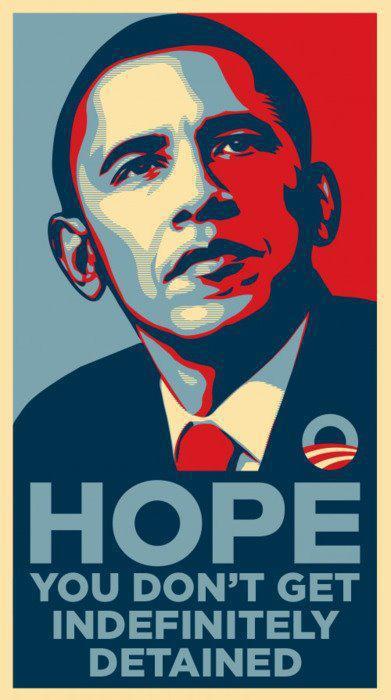
In signing the NDAA, Obama crossed a line too far for me to consider voting for him again. I won't be voting Republican, but I won't be voting for Obama. Otherwise, I'm not sure what I'll do come the election, but I cannot ignore in the Obama Presidency what I could not tolerate about Dubya's. Obama chose Bush's Orwellian world over his constitutional obligation to defend our basic rights, to preserve the Bill of Rights. In the parlance of civil religion, NDAA is the unforgivable sin.

The irony here is that what I first responded so critically to--that Obama defined the national problem as exclusively that of the actions of politicians--is in 2012 the problem with the re-election of Barack Obama. It took a president to sign NDAA and fundamentally unravel our right not to be detained for speaking our minds, for nonviolent assembly, for social protest, for any reason at all. It took a president to make indefinite detainment without expectation of due process the law of the land. As he used to say in 2008, the politicians have become the problem. He is a self-fulfilling prophecy in 2012.

Wednesday, December 14, 2011

President Obama made history today for all the wrong reasons

Barack Obama went today where no one to the left of Joe McCarthy has ever gone before in refusing to veto the controversial National Defense Authorization Act, which destroys our constitutional protections against being detained indefinitely (even for life) by military forces, and it guarantees that any of us can be apprehended without just cause or guarantee of due process. Once this becomes law none of us is free:

“By signing this defense spending bill, President Obama will go down in history as the president who enshrined indefinite detention without trial in US law,” said Kenneth Roth, executive director of Human Rights Watch. “In the past, Obama has lauded the importance of being on the right side of history, but today he is definitely on the wrong side.”

The far-reaching detainee provisions would codify indefinite detention without trial into US law for the first time since the McCarthy era when Congress in 1950 overrode the veto of then-President Harry Truman and passed the Internal Security Act. The bill would also bar the transfer of detainees currently held at Guantanamo into the US for any reason, including for trial. In addition, it would extend restrictions, imposed last year, on the transfer of detainees from Guantanamo to home or third countries – even those cleared for release by the administration.

Truman never caved to McCarthyism. Obama is poised to do so. My sense is that people most likely to be violated by US military forces are not conservative critics of government, whom Obama has courted and appeased, but progressive dissenters of current federal policy. I fear for social movements the likes of Occupy Wall Street.

Saturday, November 26, 2011

The political salience of local protest outside the bounds of elections alone

I've been consistently beating the drum that local protest movements (like "Occupy") need not lead to election results in order to have political merit, despite claims from critics all over the spectrum to the contrary. Out of Oregon comes news that protesters are having a profound affect on municipal policy matters without need of political parties or the ballot box:


Two weeks after Portland mayoral candidate and state Rep. Jefferson Smith publicly challenged Portland to move some of its money to local credit unions, Mayor Sam Adams this morning said he would pursue the cause.

The mayor's comments came during the public testimony portion of Wednesday's regular Portland City Council meeting and follow on the heels of the Occupy Wall Street movement and related protests against national banks. The city of Seattle this week adopted its own "responsible banking" resolution in response to the same forces.

The city of Portland has tens of millions of dollars in Wells Fargo, one target of protesters' discontent. But it was unclear as of Wednesday what specifically Adams would do differently ....

Todd Olson, the Portlander who introduced the topic during public testimony at City Council, said following through would allow the city to "address the gross inequity that brought 10,000 Oregonians to the streets of Portland six weeks ago."


This is a textbook example of how local protest groups should target city councils and Mayor's Offices to leverage real changes that move capital from powerful Wall Street banks to local institutions with larger local bang. It is not the first time cities have departed from federal policy to leverage positive change at home. 2 decades ago cities conducted an end-around President Ronald Reagan's support for South Africa and its apartheid government. By the end of the 1980s almost 100 US cities had divested from companies doing business with South Africa.

Likewise, cities are setting new headings due to Occupy Wall Street's fight against corporate malfeasance even as the Obama Administration is doing little to regulate the finance industry. That fills an under-utilized niche that politicos and party wonks ignore or hand over to others with conflicts of interest. The American Prospect has more:


"Banking is now a salient political issue," testified Olson before the city council. "Where local governments choose to bank is a political and social act."

It sure is. Now. And it would take a hearty dose of self-delusion to think that Occupy Wall Street hasn't contributed to creating a moment where wonky discussions of credit union collateralization are perfectly normal. That's true even if the folks in Zuccotti Park aren't the ones churning out white papers. That's how change politics works. And if Bloomberg thinks that "things aren't working well," another option would be for him to help figure out sensible responses, instead of chiding Occupy Wall Street protestors for not presenting end-to-end solutions wrapped in a bow, without anyone else's participation. That's a rather sad view of how change happens.


Hopefully, this trend will spill over to protesters here in Tennessee, and we will start to see pressure put on Mayors like Karl Dean to stop Metro Nashville investments in our abusive and malfeasant finance industry (the Dean Administration climbed into bed with unseemly Goldman Sachs to finance the new convention center).

Wednesday, November 16, 2011

Beating up protesters is much easier than plugging potential security breaches in local utilities

Last week I had an interesting chat with a former security guard employed by Metro Nashville contractor Wackenhut to guard the Downtown water treatment plant near Salemtown. He told me that he believed the potential for catastrophic, lethal chlorine spill was real because the system does not have tight oversight.

Reportedly, the FBI is supposed to be regularly testing the security of the chlorine railroad tanker cars that deliver the concentrated toxic chemical during the water treatment process, but he never saw any conducted. He said that chlorine leak alarms went off several times in the small control building next to the tankers while he was on duty and that the building is supposed to be airtight, but on a number of occasions security personnel had to don gas masks while responding to the alarms.

Whenever there was a leak on-call "specialists," some of whom did not act like they knew how to resolve the problem, responded, according to the former guard. He also confirmed what has been reported in the past by others: the complex is remarkably vulnerable to sabotage given its proximity to Downtown Nashville.

Sandbagging tankers against the 2010 flood. 
It has been frustrating enough watching what looks a tragic accident (or act of terrorism) waiting to happen get attention from outside sources while Metro, state, and federal government officials seem to ignore the threat. A major chlorine spill would be a catastrophe for Downtown and both sides of the river. However, what I find even more galling is to watch how government misdirects its security forces away from real threats and toward innocuous inconveniences like the modest protests of dissenting citizens. Take the Department of Homeland Security, which assisted the Tennessee Highway Patrol's misguided crackdown on the relatively small Occupy Nashville protest. Give the protesters credit. They've fought the battle of Legislative Plaza against the state, gone to jail and won in the courts, and been acknowledged across media (along with overwhelming public support) for their perseverance.

Nevertheless, the committed followers who continue with the group beyond Governor Bill Haslam's bumbling heavy-handedness do not seem to expand. Moreover, ON has really not done much to occupy Nashville or otherwise live up to their name. They have not shown the slightest interest in occupying Nashville's Courthouse or the Chamber of Commerce or Gail Kerr's writing cubicle or the windmills of Jerry Maynard's mind or any other place of local political influence in Nashville. They've picketed NES and staged a street play at CCA. Today they're going to occupy the Tennessee Tower. They've basically given Mayor Karl Dean  (a Democrat with political aspirations) a pass. None of this is to slight the alternative democracy they're trying to run in the form of General Assemblies.

But really, was their nonviolent unwillingness to leave state-owned public property worth the attention of Homeland Security or the FBI or any other federal agency sworn to protect Americans against enemies, foreign and domestic? DHS overstepped its boundaries in assisting Bill Haslam's act of stepping on his own feet in the ON crackdown. Why are they not more focused on finding terrorists who might strike in Nashville or on securing vulnerable targets like the chlorine tankers at the Downtown water treatment facility?

Now we see reports that agencies like Homeland Security and the FBI may be coordinating responses with city halls across the country to suppress popular backlash against Wall Street and the financial industry. I have to wonder, given that President Obama broke his campaign promise to close George Bush's oppressive GITMO detention camps, whether the White House might actually be encouraging municipal and state-sponsored gagging of dissent as well as the compromise of universal human rights at home.

I notice this morning that Juan Cole is worrying about it, too:


Oakland Mayor Jean Quan let slip in an interview with the BBC that she had been on a conference call with the mayors of 18 cities about how to deal with the Occupy Wall Street movement. That is, municipal authorities appear to have been conspiring to deprive Americans of their first amendment rights to freedom of assembly and freedom to petition the government for redress of grievances.

Likewise, A Homeland Security official let it slip in a phone interview that the FBI and the Department of Homeland Security had been strategizing with cities on how to shut down OWS protests. The FBI is said to have advised using zoning ordinances and curfew regulations, and to stage the crackdown with massive police force at a time when the press was not around to cover the crackdown ....

What these two reports show is a high-level conspiracy to deprive Americans of their constitutional right to protest peacefully.

When will we see Occupy Wall Street protesters hooded, dressed in orange jump suits, and sent to Guantanamo for military trials? When you let the government act without regard for the rule of law toward foreigners suspected of terrorism, you open yourself to be treated the same way if the rich decide to sic their police on you (it is mostly their police).


Chapel Hill, NC cops suppress OWS protesters who occupied
an abandoned building to perhaps start a free clinic
-- KATELYN FERRAL AND MARK SCHULTZ
Sounds like the FBI is too distracted with aiding local police--who in turn act like paramilitary thugs toward nonviolent protesters--to spend much time testing for security holes at strategically significant utilities like Metro Water Services. I would agree with those who argue that if Homeland Security is coordinating these crackdown efforts against Occupy Wall Street, then we are not very far away from the day when we will see protesters rounded up and detained GITMO-style. The federal security apparatus, whose overseer is the President of the United States, needs to keep its eye on the ball and focus on potential local threats that are real. It should avoid micromanaging protest response as if it were quelling hostile coup d'etat. It ought to fix holes in the system rather than rolling back the civil rights of Americans.

Friday, September 30, 2011

The education reform industry is doing to public education what General Motors did to public transportation

Financial incentives for building highways nationally culminated in the 1956 federally-funded interstate highway system, a huge project that made car companies like General Motors unimaginably wealthy. GM worked with city planners like New York's Robert Moses to market urban renewal, tearing down old pedestrian neighborhoods and slashing them up with interstate highway systems, to serve the migration of the mostly white middle class out of cities. Federal money stacked up against urban renewal perpetuating blight and creating ghost towns enabling criminal behavior further perpetuating the myths of already-privileged suburban sanctuary. Consequently, the primary transportation of cities, public transit withered in many cities as demand decreased, further adding to the car industry boom.

This week in Time magazine, a co-founder of Bellwether Education, a private non-profit that has benefits from education reform, laments that Tennessee Senator Lamar Alexander (among others including President Barack Obama) is trying to dismantle education reform by giving states more latitude in dealing with their underperforming schools. God knows the last thing I want is red-state Tennessee further undermining public education at the local level.

However, the Bellwether critic is sadly mistaken that Senator Alexander's moves are moves against education reform. Moving control of education to the state level is the logical extension of NCLB and Race to the Top, because education reform is bent on fracturing and dismantling public education itself. Allowing charter schools effectively skims high performing students from public schools and creates a self-fulfilling prophecy that public education only attracts the dregs of society and holds kids back.

The reality is that education reform is the urban renewal of the 21st Century. Urban renewal attempted to by-pass old structures, which only manufactured more blight, which became the justification for tearing down and breaking up communities while wealth and poverty pooled and concentrated into a two-tiered America. It and racism and the automobile industry conjoined to literally drive large segments of the middle class out of once diverse cities and crippled or destroyed once robust mass transit. Renewal disciples like Moses used rising urban blight and poverty to justify even more renewal.

Likewise, while education reform may be providing hope for some families, it still perpetuates a social-Darwinistic system of haves and have-nots, and many non-profits and for-profit education companies are making money off stratification and misery. Charters still lag in performance, but only a fortunate few get into the ones that function well. In the meantime, public dollars and good students are siphoned out of public schools (where African American students continue to be disproportionately disregarded) and decay sets in, further justifying education reform's mission.

While education will continue to deteriorate because of the reform movement, private education companies and organizations will make money in the federally supported and foundation backed privatization climate. And even if the reform market turns from bull to bear because of declining federal intervention, the corporations will find a way to profit off the losses, too. Public education is the ultimate loser either way.

Wednesday, September 07, 2011

A one-two punch to public education

Metro Nashville Public Schools has been flying to "education reform" money and influence at the federal and state levels like a duck on a June bug. Starting with custodians and extending to charters they have been privatizing to flip public obligations to millions in corporate dollars. They have enlisted organizations that have impeded and eroded public education in other states. It has been consistent with David Sirota's framing of education policy in terms of Shock Doctrine:

as the overall spending pie for public schools is shrinking, the piece of the pie for high-tech companies -- who make big campaign contributions to education policymakers -- is getting much bigger, while the piece of the pie for traditional education (teachers, school infrastructure, text books, etc.) is getting smaller.

... the spending shift isn't producing better achievement results on the very standardized tests the high-tech industry celebrates and makes money off of ....

Tech companies give the politicians who set education policy lots of campaign contributions, and in exchange, those politicians have returned the favor by citing tough economic times over the last decade as a rationale to wage an aggressive attack on traditional public education. That attack has included everything from demonizing teachers; to siphoning public money to privately administered schools; to funneling more of the money still left in public schools to private high-tech companies.

This trend ... is a deliberate strategy by corporate executives and their political puppets, a strategy that uses the disaster of recession-era budget cuts as a means of justifying radical policies, knowing that the disaster will have shellshocked observers asking far fewer questions about data and actual results ....

Or as [education consultant Tom] Watkins explains, social pain is an opportunity: "Let's hope the fiscal crisis doesn't get better too soon. It'll slow down reform."

.... according to the Obama administration, standardized tests are the perfect tool to judge and punish struggling schools and the teachers who work with low-income kids, but they can't be used to similarly judge technology products that are making Obama's high-tech donors lots of cash.

In this oxymoron, we see who the corporate "reformers" in government really believe they work for, and whom they shape public policy on behalf of. It's not the average parent or student or voter. It's the Disaster Capitalists, who now have their sights set on your local schoolhouse


And now comes word that President Obama is working on a jobs plan in which even more money will be pumped into education within the larger context of education reform:


State and local governments, facing budget shortfalls, have turned to school systems to make up the difference. Only three states increased funding for education in FY 2012 -- the rest cut it by millions. California, in a particularly alarming example, laid off an estimated 19,000 teachers as of this spring ....

The refurbishing of schools could have an even larger economic multiplier effect. Currently there is an estimated $270 billion to $500 billion backlog in school maintenance and repair projects nationwide ....

Sources familiar with White House deliberations have said that advisers to the administration are weighing the merits of the Fix America's Schools Today (FAST) program, which would fund the maintenance and repair of public schools. The distinction between school construction and repair is an important one. The former would involve enhanced federal assistance and longer-term investment. Repair would have lower capital costs and less of a federal imprint.


What drives progressives like me crazy is that Obama usually talks a good progressive game plan (and he no doubt will when he offers the job plan), but the execution of his actual policy is conducted by those in his inner circle invested exclusively in the world of high finance. They are pulling the strings in the "reform" that is shaking public education to its foundations. The jobs bill will provide just enough inertia to highlight the connection between education and jobs, but it will also open the door to more education reform.

So, my sense is that FAST money will likely go to school repair/construction projects that advance the interests of business first. Outside of a few short-term jobs that temporarily stimulate the economy, buildings used for non-traditional uses will get more attention than most of the public school infrastructure. The scope will not be wide or long-term and implementation will prey on the general desperation people feel for jobs in this climate.

Hypothetically, if money comes to Metro Nashville, my guess is that it would be earmarked not to fix buildings in traditional public schools but that it would go to projects like those that renovate existing school buildings for charter and non-traditional schools. Leaking roofs will continue to leak. Long put-upon students still won't have lunchrooms or gyms. The prevailing trade winds here blow directly away public education. Take a recent groveling Tennessean story by Julie Hubbard hawking education reform:


Charter management groups took over troubled schools in New Orleans, Los Angeles and other American cities, with those districts seeking a fresh approach to long-term problems.

They’ve been dubbed the kings of turnaround, and now those groups are coming to Tennessee.

Metro Nashville hosts the concept on a small scale — LEAD Academy, a charter school, runs one grade of Cameron Middle School this year and will take over a grade a year. But many more charter groups are submitting bids, due Sept. 15, to run some of Tennessee’s worst-performing public schools ....

With about half of America’s 3 million teachers on the verge of retirement by the end of the decade, this could be the time to make dramatic changes to teacher recruitment and compensation ....

The new structure should shift from an industrial-era, blue-collar model of pay to one that rewards effectiveness and could include paying high-quality teachers with increased class sizes more money.

Tennessee is taking a shot at this sort of performance-based pay plan this year, giving 13 districts the ability to award bonuses to teachers who move their students well ahead of average gains.


Aside from writing like she is bucking for a future job in public relations, Ms. Hubbard seems to resort to code when replying to teachers and their right to collectively bargain: "industrial-era, blue-collar" makes teachers unions sound regressive, even antique. As if business-influenced politicians are naturally going to pay teachers fairly without any pressure to do so. In reality, teachers unions are the primary obstacles to Disaster Capitalists completely overrunning and dumbing down public education to suit their profit motives.

But reading the Tennessean in an exploding context of education reform in Nashville, of the millions poured into charter schools here and of the pandering speeches of Mayor Karl Dean and MNPS Jesse Register to business groups like the Chamber of Commerce, I see one sexy option the Obama Administration might want to consider just a few blocks down:


While the Civic Design Center suggested a magnet school, a charter school might maximize returns. So, after a slight tune-up, this concept would present a robo-growth combination: a ballpark designed above all to make wealthy local developers wealthier book-ended by a privately-run public school with no "blue-collar" unions to hassle MNPS and lots of new contracts to sign with education corporations and consultants. Government money would stream ineluctably into both projects.

The multiplex Sulphur Dell concept is pure gold; unless you're on the business end of education reform's one-two punch, watching your dignity siphoned off by misplaced logic that your education sucks and watching your district's resources siphoned off to propped up, unaccountable charter schools.

Monday, August 15, 2011

Obama's education reformer comes to Tennessee bearing waivers, not much else

Obama Education Secretary Arne Duncan was in the state last week failing to reassure teachers or education reform critics in his discussion.

Education blogger Jim Horn sees it as an occasion for public school stakeholders to consider more drastic measures:

Tennessee is already in eager pursuit of fulfilling all the criteria required to earn a waiver from Adequate Yearly Progress demands: 1) uncapped status on charter expansion, 2) uncapped expansion of centralized pre-K to Retirement testing systems, 3) bonus pay and teacher evaluation based on test scores, and 4) embracing the worthless turnaround strategies devised by the Gates and Broad technocrats who remain clueless about schools or learning.

We shall see how many states rush to get in line to now do for no money what large [Race to the Top] bribes could not make them do before. We shall see how many parents and teachers and students just say no to the testing madness this coming year. The movement is born and moral action now requires the sacrifice that comes with civil disobedience and non-violent resistance .... It is time to act and demand that educators be put in charge of educating our children for the most trying time in the history of our civilization. The fools and thieves of Wall Street have ruined the world’s economic systems—we shall not allow them to ruin our children any further.

Meanwhile, the teachers union rep says Tennessee teachers are worried:

The forum at Nashville's West End Middle School marked the first anniversary of Tennessee winning $500 million in U.S. Department of Education "Race to the Top" funding.

The money is for a variety of school reform measures adopted by the state in 2010, including a new teacher evaluation system effective with the new school year.

Tennessee Education Association President Gera Summerford said there's "a lot of anxiety among teachers," partially about the new evaluation system. She said teachers want clearly defined goals in the evaluation process so they know what they must achieve.


How long will Tennesseans put up with the lack of progress when so much racing to the top was promised?

Wednesday, July 06, 2011

Popped up on the stat counter during today's "Ask Obama" twitter session

Enclave has had visits from various and sundry federal government entities before, but this is a first:

Tuesday, July 20, 2010

It's still the economy, stupid

There continues to be 2 disparate Americas in the national consciousness according to Pew. President Obama's rather weak economic solutions have not curbed popular frustrations with a big government that protects big business first:
The public sees clear winners and losers from the economic policies the government has implemented since the recession of 2008. Most Americans say these policies have helped large banks, large corporations and the wealthy, while providing little or no help for the poor, the middle class or small businesses.

Fully 74% say that government policies over the past two years have done a great deal (53%) or a fair amount (21%) to help large banks and financial institutions. Majorities also say that large corporations (70% great deal/fair amount) and wealthy people (57% great deal/fair amount) have been helped.

By contrast, 68% say government policies have helped small businesses not at all (29%) or not too much (39%); 68% also say middle-class people have received little or no help from these policies. And about the same percentage (64%) says poor people have not been helped.
I believe Americans expected better from Democrats in charge in Washington. The latter have failed to sustain any pretense of champions of common folk.

Sunday, January 24, 2010

A lesson that popular backlash at late night TV holds for Obama

NY Times' columnist Frank Rich encourages the President to look to the dysfunction of the Tonight Show to get past petty populist symbolism:
There’s a reason why the otherwise antithetical Leno and Conan camps are united in their derision of NBC’s titans. A TV network has become a handy proxy for every mismanaged, greedy, disloyal and unaccountable corporation in our dysfunctional economy. It’s a business culture where the rich and well-connected get richer while the employees, shareholders and customers get the shaft. And the conviction that the game is fixed is nonpartisan. If the tea party right and populist left agree on anything, it’s that big bailed-out banks have and will get away with murder while we pay the bill on credit cards — with ever-rising fees ....

On the economic front, Obama needs both stylistic and substantive makeovers. He has stepped up the populist rhetoric lately — and markedly after political disaster struck last week — but few find this serene Harvard-trained lawyer credible when slinging populist rhetoric at “fat-cat” bankers ....

When it comes to economic substance, small symbolic gestures (the proposed new bank “fee”) won’t cut it. Nor will ineffectual presidential sound bites railing against Wall Street bonuses beyond the federal government’s purview. There’s no chance of a second stimulus. The White House will have to jawbone banks on foreclosures, credit card racketeering and the loosening of credit to small businesses. This means taking on bankers who were among the Obama campaign’s biggest backers and whose lobbyists have castrated regulatory reform by buying off congressmen of both parties. It means pressing for all constitutional remedies that might counter last week’s 5-to-4 Supreme Court decision allowing corporate campaign contributions to buy off even more.