Sunday, May 02, 2010

Photos of 2010 Nashville flood, Cumberland River, Central Wastewater Treatment Plant

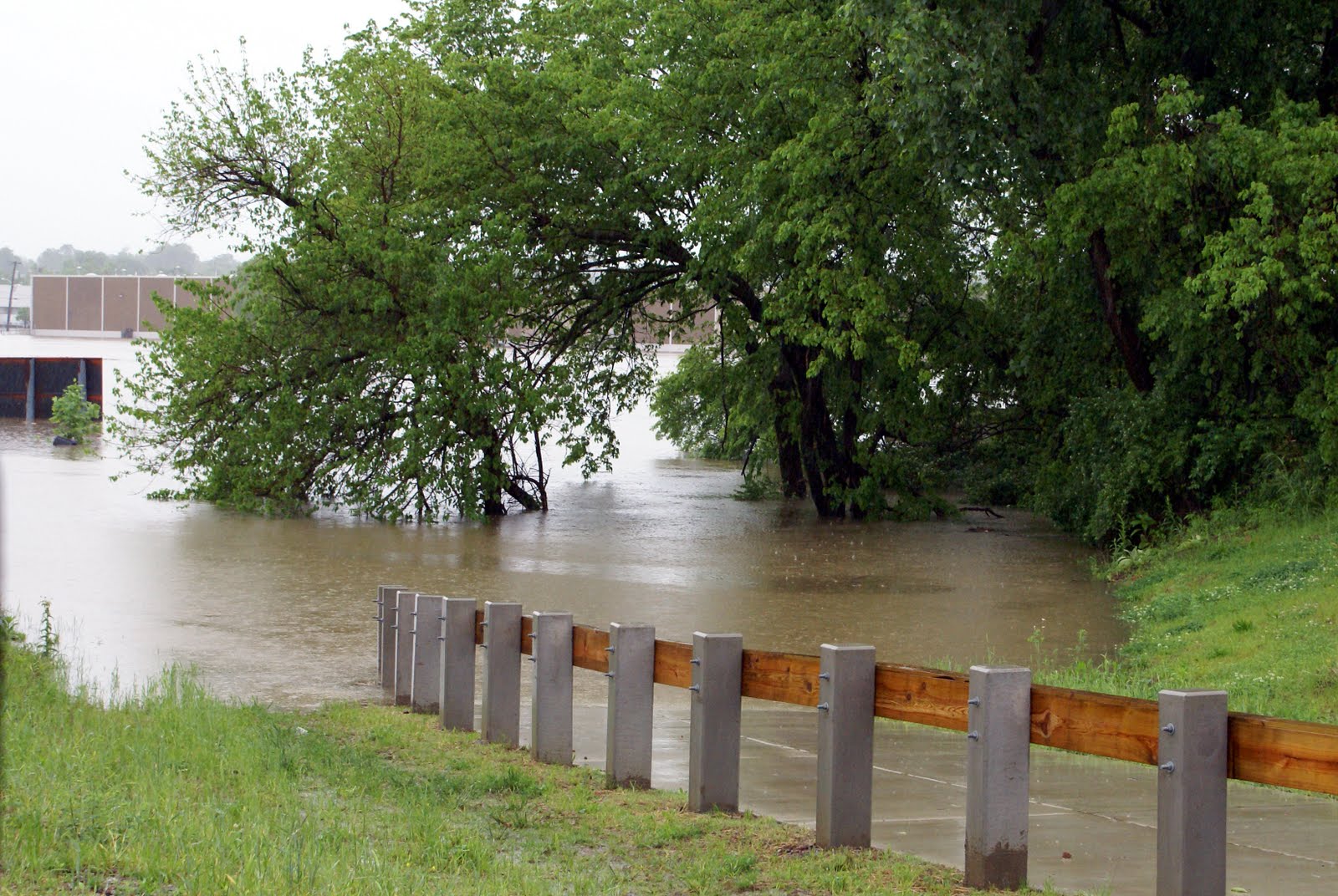
Before sundown I took one more trip 5 blocks east to check out the Cumberland River's rise. The difference since this morning is dramatic. Usually the river is some 200-225' down the embankment from Cement Plant Road (old 2nd Avenue), which stands between the river & the Central Wastewater Treatment Plant.

This evening, as shown in the photos below, the water is a few feet from topping the embankment and spilling on to the road. As I write it may already be there. I don't know. But I did see a number of Metro Water Service employees on the road waiting for something. Not a sand bag in sight. You should be able to see the roofs of a couple of submerged sheds clearly below the road.


FEBRUARY 23, 2019 UPDATE: today's rain amount made this the wettest February in Nashville on record since 1880 (by the way, the wettest month on record in Nashville was May 2010). For the sake of comparison, look at photos from this afternoon in basically the same places along the Cumberland River Greenway.


Photos of 2010 Nashville flood, Farmers' Market, Bicentennial Mall, Rosa Parks Boulevard (8th Avenue)

Flood scenes around the foot of Capitol Hill (Tennessee Capitol Building). I took all of these photos this afternoon.


Photos of 2010 Nashville flood, more from Hope Gardens


10th Avenue, North toward Downtown Nashville


Locklayer toward Nashville Farmers' Market

Photos of 2010 Nashville flood in MetroCenter and Buena Vista Heights


A MetroCenter building owner told me that both area lakes had topped their banks causing flooding of the roadways.

Photos of 2010 Nashville flood on Cumberland River greenway


Part of the Downtown section of the Cumberland River greenway near Salemtown. Trees, bench, trash can are completely submerged. If I had taken these pictures from the same spot I stood this morning (compare here) I would have been in the water.

Video of 2010 Nashville flood at Farmer's Market

Photos of 2010 Nashville flood in Hope Gardens

Flooding on 9th Ave N in front of Row 8.9 in Hope Gardens, Na... on Twitpic


This is 9th Avenue, North near Nashville Farmer's Market (via Marlaink)

Photos of 2010 Nashville flood around the North End


Cumberland River inundates part of the Downtown section of the Cumberland River Greenway during 2010 flood this morning.


Closed Rosa Parks Boulevard flooded by 4 feet of water near Row 8.9 townhouses.


Flooded Nashville Farmers' Market on Rosa Parks Boulevard.

Monday, April 26, 2010

2010 Country Music Marathon photos

Unfortunately, I did not get to take as many images of the Country Music Marathon to blog as I have in past years because I had to be out of town the afternoon of the race. In a typical race year I drift from Werthan Lofts to Farmers Market to Downtown to MetroCenter snapping photos. During the hour I spent watching the elite men and women racers followed by the leading average runners, these are some I was able to take around Werthan, Salemtown, and Jefferson Street. Enjoy.


Sunday, April 25, 2010

North Nashville leader believes Metro can do more to prevent crime

From his vantage around 10th Av., North and Coffee St., professor Sekou Franklin believes that Metro law enforcement should strive beyond suppressing crime and be more proactive in engaging the community in prevention:

As a social scientist, I have examined various crime reduction strategies. As a resident who has been afforded more opportunities than most of my neighbors, I have observed Nashville's approach to remedying violent crime. Suppression alone will not solve violent crime in inner-city neighborhoods already traumatized by violence and neglect. The police department's zero-tolerance approach, emblematic in its Operation Safer Street initiative, leads to over-policing, distrust and racial profiling.

An alternative to suppression that Nashville may want to consider replicating is the Measure Y initiative (www.measurey.org) in Oakland, Calif. The $20 million annual program offers a holistic approach to crime reduction. This includes the hiring of six dozen police officers, many of whom belong to specialized units dedicated to community policing and school safety instead of suppression. Additional money is allocated for fire safety, emergency service, school-based conflict resolution counselors and community interventionists (respected community activists with ties to gangs and at-risk youth) who canvass high-crime neighborhoods in order to prevent retaliation killings in the aftermath of violence.

2010 Country Music Marathon elite men's race produces first non-African winner


Columbian William Naranjo won the men's side of the 2010 Country Music Marathon after keeping pace with the leaders through Germantown. In the photos above Naranjo (#10) is in the middle of the pack at the 12 mile marker and hangs in second place approaching the 19th mile.

Saturday, April 24, 2010

2010 Country Music Marathon has its first American winner


While she trailed Ethiopian runner Serkalem Abrha (left-F1) at the 18 1/2 mile in Germantown during the women's marathon, Ilsa Paulson (right-F2) rallied to become the first American, man or woman, to win this race.

Friday, April 23, 2010

An eye opener!

I'm getting a little lesson on just how unmonitored and unsupervised municipal bond issues--like those backing the new convention center--are over at CM Emily Evans twitter stream. Jump over and see what a wild, wild west it is. My Twitter stream is available here in the right-hand column in the black box.


UPDATE: The most salient point in CM Evans' twitter stream concerns the governing body that Congress appointed to regulate and protect municipalities on bond issues, the Municipal Securities Rulemaking Board (MSRB), whose appointees are a small group of finance industry insiders from banks like JPMorgan:


We have to ask at this point, if it is rigged, was it rigged against Metro Nashville when Mayor Karl Dean went to Wall Street last week and lauded the market for "validating" his convention center plan?

Thursday, April 22, 2010

Comment away -- sorry for the delay

Sorry to those of you who left comments the past couple of weeks. They were sitting in my queue without approval because of an error I made with e-mail notifications. After getting a heads up today, I went in an approved them all. I also fixed the e-mail notification problem.

I appreciate the positive response to my return to blogging, and particularly enjoyed the digs at the local news media. Thanks for being patient with the technical problems.

Local union alleges that public schools director met for months w/private contractors and relied on their projections before proposing to privatize

From SEIU Local 205, the union that represents Metro service workers:
SEIU Local 205 released a series of internal emails that reveal that administrators at Metro Nashville Public Schools have been working behind closed doors to push forward a plan to privatize custodians and groundskeepers as far back as November, 2009. The union also found that Dr. Register’s statements of a $5 million dollar cost savings to the district were based on a claim made by one of the contractors who is bidding on the project, not through a scientific cost-benefit analysis or impact study (see page 1 of Attachment, Item #3).

As a result of an information request from MNPS, union officials discovered that school administrators have been contacting and meeting in secret with representatives of GCA Services Group, based in Knoxville, with regards to outsourcing as far back as November 18, 2009, though even those emails indicate that there had been previous communications before that. Register had not mentioned any interest or inclination in privatizing these two departments until he released his budget on March 11. “Register has said that the reason he wants to outsource 700 custodial workers’ jobs is because of the economy, but he was negotiating with a contractor months before anyone even knew what the city’s revenue was,” said Doug Collier, President of SEIU Local 205, who represents support staff in Metro Schools. “Keep in mind that Register has privatized custodial services in his previous positions in Chattanooga and in North Carolina. He didn’t use the economy as his excuse then because he couldn’t. Now he could, and he has.”

Largely because of assurances by Dr. Register and School Board member Steve Glover that a savings would be seen, the Board narrowly voted to accept the budget by a vote of 5-4. “Dr. Register has not been a straight shooter with the School Board who hired him or with the public,” says Teresa West, a food service employee at MNPS. “He is claiming some kind of dire economic emergency, but now we know that he was just out to privatize our jobs.” West says that the $5 million savings that Register claims will happen from the privatization will have to be paid by taxpayers anyway since many custodians will have to go on public assistance once they lose their jobs or see their pay and benefits cut. “Because of his drive for privatization, Register has opened the district up to lawsuits since 88% of the workers affected are minorities and because GCA may have been given an unfair advantage in the bidding process.”

GCA Services, the company that school administrators were in contact with, is expected to bid on the custodial and groundskeeping contracts since their representatives were present at a March 26 question and answer session for prospective contractors. The bidding period on the contracts close this Friday.

Mayor Dean has yet to present his schools budget to the Metro Council and he has not taken a position on whether or not he will support the School Board’s proposal to outsource nearly 700 custodians and groundskeepers. He has until May 1 to present his version of the budget to the Council.

Wednesday, April 21, 2010

Nashville's new convention center debt a "leap of faith"

From last week's Music City Center piece by Bloomberg, overlooked because the local media focused strictly on some anonymous Courthouse grumbling about CM Emily Evans' quotes in the piece:
With convention center attendance down nationwide -- a 30 percent decline in Las Vegas and 28 percent in Orlando, Florida, two of the largest convention markets in the U.S. -- Nashville’s taxpayers may wind up paying part of the cost if use of the new center falls short, said Heywood Sanders, professor of public administration at the University of Texas in San Antonio, who has studied convention centers.

“It’s quite a leap of faith,” said Sanders, who’s writing a book on convention center financing. “It’s a pretty large chunk of debt.”

The city is selling in four parts, with about $605 million as taxable Build America Bonds, which come with a 35 percent subsidy from the U.S. government under economic stimulus legislation passed last year by Congress.

The average yield on Build America securities fell 6 basis points to a three-week low of 6.17 percent yesterday, according to the Wells Fargo Build America Bond Index. A basis point is 0.01 percentage point.

What happens to our rights in public-private parks?

I had the opportunity to chat face-to-face with former CM Lynn Williams at an online news conference a couple of weeks ago. Our chatter involved local politics, guns in bars, smartphones, and private parks.

It was the latter topic that especially sparked my curiosity. During a conference session on legal issues in recording news events on smartphones, the legality of shooting footage on public vs. private space came up. That spurred the following tweet from Lynn:


At the end of the session we met up, and she elaborated on her point. She had in mind Harding Academy's acquisition of private property to build a public park for its own athletics program. Since the "public" park is actually privately-owned, would someone recording a news event there have to get consent from the school to share that footage? A chronicler or reporter can legally record news on public property without permission, but when s/he sets foot on private property, consent must be attained. Thus, if I videotaped a Harding parent assaulting another parent's kid on Harding's ballfield, consent seems a murky issue, even with public park permits.

I replied to Lynn that the same problem arises with Belmont University's lease of Metro Nashville's Rose Park to build its baseball, softball, and soccer fields over the heads of neighborhood protests. While the hyper-locals are concerned about traffic, zoning, and open meetings, another problem that arises is the question of consent to record news events in Rose Park while Belmont is exercising its lease rights. Metro may be so cash strapped that it has to offer public park space to high bidders, but the question of whether we can video- or audio-record events that unfold on privately reserved land without Belmont's consent becomes more murky (granted, I'm not a lawyer).

The underlying squeeze here is the often vaunted, infrequently examined notion of public-private partnerships. While that amalgam may provide new opportunities to pool resources and reduce replication of services, it seems to become a sticky mishmash of legal problems for free individuals who intend to exercise their rights of expression in public space while respecting privacy rights. Those who try to document and record events that unfold in their communities must become more attuned to the obstacles erected by public-private partnerships. We ignore them at our own peril.

Tuesday, April 20, 2010

North Nashville Community Plan: Salemtown Scenarios, Part I

For weeks now I've had questions from Metro Planning sitting on my desk regarding community plans for Salemtown for the next 10 years. I got them because Planning scheduled the Salemtown-Germantown community meeting during the week of Metro Schools spring break, when we were on spring break. I attended the meeting before that for the Jones-Buena Vista neighborhoods, since I am a Jones Paideia parent. However, I was told that I should either answer the questions for Salemtown either by e-mail for Planning or attend a later meeting with MetroCenter "neighborhoods." It made no sense to me that I could have input at the MetroCenter meetings, but not with the Jones-Buena Vista meeting, which was not exactly well attended, so I did not attend the MetroCenter meeting even as I played by the rules at the earlier meeting.

All that is to say, I'm going to give my feedback to Planning's questions via e-mail and I'm going to publish them on this blog. I've already given some of my input at the Jones-Buena Vista meeting: sound barriers for the I-65 corridor that cuts through Jones & Salemtown, a spoke-like greenway that connect the Jones neighborhood to the Looby community center and beyond that through MetroCenter to the Cumberland Levee greenway, making Buchanan Street a more sustainable business area. But I have many more ideas for Salemtown. So, here we go.

Where are the existing parks in your community? Do the existing parks in the neighborhood meet your needs? If yes, how do they meet your needs? If they do not meet your needs how can it be improved to do so? Open space does not always have to be a park. If other open space exists or is needed what type of open space would it be and where would it be located?
The existing parks in Salemtown include Morgan Park and the Downtown Connector Greenway. The greenway system meets the pedestrian and biking needs of the community well. It is prone to some abuse by vehicular traffic as I have seen cars parked on walking paths at Morgan Park for athletic practices and on the Cumberland River for people who fish. Also, trash is dumped at some spots along the river, which calls for both surveillance and receptacles. Finally, there were some young trees planted along the connector during the drought a couple of years ago that were not watered in a way to match the harsh weather. They have been taken out and should be replaced.

The changes at Morgan Park over the past few years seem to minimize children's participation. Greenway development, a new fountain, and landscaping attract adults, but the baseball diamond that existed for generations was removed a couple of years ago and the field remains undedicated to anything but random use. It took us years to get a dangerous old playground demolished and a new one put in, but the new one is small. The playground could use a few more features dedicated to children of various ages.

Another greenspace that needs landscaping work is the strip that runs in front of Metro Water Services on 3rd Avenue, North from I-65 on the north to the Magdeburg greenway spur on the south. Salemtown residents have an ugly view of the Central Wastewater plant. Either the plant needs to do more to conceal its sewage tanks or someone should put up screening trees and shrubs along the green 3rd Avenue strip.

The 2002 neighborhood plan called for this green strip to be a civic open space. To become civic, it is going to need sidewalks or paths, landscape architecture, seating, and an attractive blocking wall instead of a chain link fence running the length of the plant's edge. These are some of the basic ingredients that make small public spaces attractive. Other possibilities include water features (which could recall the plant-obstructed Cumberland River) and a possible Riverfront Redevelopment Plan Transit stop (perhaps a trolley driveway). Research indicates that elements like these make urban spaces social. 3rd Avenue has been the neglected part of Salemtown. Converting the MWS strip could turn that around.

Finally, another green strip that needs some attention is that abutting Coffee Street and I-65 from 3rd Avenue to Rosa Parks Boulevard. A previous neighborhood plan called for pocket parks in that area. Regardless of whether that happens, some sort of sound-blocking screen should be constructed between Salemtown and the interstate highway. West Nashville residents enjoy a sound wall along I-440, while chain link fences seem to be TDOT's answer for North Nashville. Either a sound wall or a screen of large trees and shrubs should be installed to block Salemtown from noise and sight pollution.

Metro Nashville needs to spend at least as much energy and effort on the North Nashville parks and greenspaces as it does on the public jewels in West Nashville and the East End.

Friday, April 16, 2010

Metro Public Schools privatization wall of shame

Governments who privatize services claim that their goal is to "save money," even when there is evidence that past attempts to privatize utilities and toll roads drive up expenses. The saving money claim is a smoke screen to mask more dubious interests: to spread government largess to wealthy companies and influence peddlers and to break unions that serve to protect workers.

Nonetheless, Metro Schools Director Jesse Register proposed a budget to the Mayor several weeks ago that would include privatizing MNPS service positions, including janitors and bus drivers, under the debatable rationale that it would save money. He also unsettled the herd by saying that his only other option was laying off teachers. His proposal was passed by a slim majority of the school board in a curiously untelevised, but undeniably momentous budget meeting. I'm adding the board members who voted to sell out our public school service providers to the highest private bidder to my privatization wall of shame:
  • JoAnn Brannon
  • David Fox
  • Steve Glover
  • Gracie Porter
  • Kay Simmons
David Fox was heralded as the Chamber of Commerce's hand-picked choice for the school board, so I am not surprised in the least that he voted for a plan to put more local government money in the pockets of private enterprise (a.k.a., "running government like a business"). However, I am sorely disappointed in Gracie Porter, whom I have talked up in the past. The Service Employees International Union, representing the public schools service workers, must also be miffed at Ms. Porter, whom they endorsed in the previous election.

Those board members voting against selling out school support staffs included Sharon Gentry, Karen Johnson, Ed Kindall, and Mark North. They all deserve our thanks for supporting the dedicated service staffs that play an important role in the daily functioning of our schools. Special kudos to my own representative, Ms. Gentry, who was not endorsed by SEIU in the last election, but who nonetheless voted with them and with the parents of children who are concerned about the repercussions of privatizing public schools.

There is one final note I should make about this sorry episode in Nashville's public education history. Metro 3, which televises important meetings into local homes, did not broadcast the MNPS budget meeting, despite the impact the decision has on the lives of so many Nashville employees and the public school families that they serve. I sent an e-mail to the station manager asking for reasons for not showing such a significant meeting. Curiously, Metro Director of IT, Keith Durbin, replied to me, basically defending the "high level of performance and citizen satisfaction" with Metro 3's programming in general. Durbin went on to say that Metro 3 would have televised the meeting had they been advised of it. However, I cannot fathom why the only municipal television station was unaware of a remarkably publicized and significant budget meeting regarding our highly visible school system. And there is the vexing question: why did MNPS fail to notify Metro 3 about this meeting in order to help citizens stay informed?

School service workers' jobs can still be saved if Mayor and Metro Council reverse the schools Director. I do not know yet whether we will be privy to those deliberations since we can only count on Metro 3 to televise the meetings requested by meeting sponsors. Nevertheless, more than a few people need to bear responsibility for the bad call if service to our children, their parents, and the teachers suffers as a result of privatization, which typically spreads money around instead of making things better.

Wednesday, April 14, 2010

A teachable moment of silence in a Metro Nashville Public School

I have developed a habit of walking my 6-year-old daughter to her Kindergarten classroom several mornings a week. We both seem to enjoy it. I get to interact with both her classmates and her teacher, which gives me a better feel of what goes on for her each weekday while I'm at work.

One morning last week we exercised our ritual a little later than usual and got there just as the "tardy bell" rang. The teacher was in the middle of reminding a small group of kids about when and where to use punctuation in sentences when we arrived. She naturally got distracted with that and did not pay attention to an invitation over the loudspeaker for a moment of silence, which I suppose is deference to those conservative political forces outside that demand prayer be "put back" in public schools. As if kids ever did a lot of praying when it was promoted (that's a discussion for another day).

The teacher caught herself and apologized to the class for missing the moment of silence. I immediately said to myself, "She's got absolutely nothing to apologize to those kids for." Let's assume for the sake of argument that the conservatives are correct and time should be allotted for whatever spiritual expression children might have at 8:00 in the morning. (Such an assumption is bend-over-backwards charitable to many conservatives who would insist on exclusively Christian expressions over any other; but again, I digress). Is not seizing a teachable moment to reinforce basic grammar skills, which these Kindergarteners will one day need in the real world, a benign, yet great alternative during a moment of silence?

There is no secular attack on religion in helping children understand when to use a question mark or a period, even if that help occurs during a moment of silence. If she had done it knowingly, I still would defend her. I believe my child's teacher deserves kudos for doing exactly what we pay teachers to do: instruct our children on how to become functional citizens in a democratic republic. It should be enough that we parents tend to those thornier matters of the spirit.

Monday, April 12, 2010

North End neighborhood leaders meet to discuss bringing baseball back to Sulphur Dell

Announcement from Hope Gardens president and baseball stadium supporter Jason Powell:

Start Date/Time: Saturday April 17, 2010 12:00 PM Central Time

Subject/Purpose: Meeting about Sulphur Dell Ballpark
Type/Format: face-to-face
Duration: approximately 1 hour
Location: Farmer's Market in the Food Court area ....

A message from the organizer:
The best time for the majority is next Saturday at 12pm in the food court area at the Farmer's Market. Let's plan on gathering in the North/East corner of the food court. If you can't make it, we'll send out some notes to everyone. Thanks!

No pleasant surprises from MDHA during my blogging break

During my sabbatical from February 8 to April 8, even with some beautiful breaks in the cold weather, very little progress was made on the Salemtown streetscape project, which should have been finished months ago. In the past few days construction crews have painted some of the stamped crosswalks, but just like last fall, warmer temperature days were wasted. And there are still lingering problems that have yet to be fixed despite the fact that I reported them to MDHA long ago and repeatedly.

We have a community meeting with MDHA tomorrow night at 6:30 announced as a kind of closure meeting in spite of the loose ends. I'm not feeling good that MDHA will finish this strong.

A worthy endeavor that needs your help


Lowell Dempsey at buildthedream.org e-mailed and asked me to remind readers that April is the 42nd anniversary of the death of Martin Luther King, Jr. One way to memorialize his noble life and tragic death is to help Build the Dream meet its goal of building a national monument in Washington DC. The foundation is only $14 million short of its $120 million goal, and they plan to dedicate the memorial in 2011. Please do what you can to help Build the Dream. Donate and/or promote through social media. Thanks.


I have also donated ad space in the right-hand column of Enclave to the Build the Dream effort. If you cannot respond immediately, you can come back to Enclave in the future and click on the Build the Dream ad to help the cause.


UPDATE (2012): What appeared a worthwhile endeavor is marred by flaws in design and in regressive working conditions for Chinese laborers.

Thursday, April 08, 2010

Some North End neighborhood associations organizing for Sulphur Dell location for Sounds stadium

Both Historic Germantown (HGI) and Hope Gardens association presidents have expressed unqualified support through e-mail correspondence for building a new minor league baseball park at Sulphur Dell (located near Bicentennial Mall between 4th & 5th Avenues at Jackson Street). That spot was the previous home of pro baseball in Nashville for a century before Greer Stadium was built.

HGI voted to support building a stadium at Sulphur Dell on April 5. Hope Gardens president Jason Powell says he has brought in some "champions" to the stadium cause (which he says will take North Nashville "to the next level") after sending out e-mails to "all neighborhood leaders in the area."

The Salemtown Neighbors Neighborhood Association discussed the initiative recently and responded favorably, but with concerns about financing, vehicular traffic impact, and sustainable design. SNNA expressed interest in participating in the process, but stopped short of expressing the enthusiasm of others along the Jefferson Street corridor.

photo credit: Metro Nashville Archives

Google fiber for communities: does Nashville have a chance?

So, Google encouraged nominations of communities for their experimental, ultra high-speed broadband service they hope will serve between 50,000 and 500,000 people in the near future. Now that nominations are closed, I wonder what Nashville's chances are?


CRIME ALERT: Crime back in Salemtown as weather warms

During the haitus, Salemtown experienced a criminological up-tick via burglary, home invasion and mugging. But, according to the neighborhood e-list, police report that they have moved in for the kibosh:
we just arrested two of three that we feel have been a big part of the issues/robberies, and assaults/Muggings and we have identified a third that got away. (We believe they and their group of friends are responsible for most of these recent issues) We caught them almost in the act and in that area, from a good profile of their descriptions and attention to locations they impacted over the last 3-4 weeks. We are doing photo line ups on other cases before we give out details. The elderly lady had talked to the subject earlier in the day at her door, when he knocked and asked her some questions. We may be able to give out some helpful tips at the next meeting how to avoid some of these issues (and again remind folks to call in suspicious persons for us to talk to etc.). This suspect was not arrested, but had gathered items to take from the residence before running off when he realized he had been detected by the home owner. We took prints and are hopeful they will return with some suspect information. Please remember that I blast out details for assistance to our partners to help us get ahead of patterns we see or forecast and try to balance creating an over reaction or panic. I will gather some detailed data, but feel confident that your area, even with the last 3 weeks of activity is lower in crime issues than in the past several years; and will even better with our recent arrest and efforts down the road.

Kick-starting this puppy

After a two-month sabbatical it looks like time for Enclave to come alive again.

Thanks for all of the supportive comments and e-mails I've received. Also, the tips and ideas on local government have not stopped coming in from readers. They made a difference during the hiatus, in the prospect that Enclave might go dormant.

Meanwhile, Enclave has two other sister projects: one is my tumblr page, and the other will be beyond hyper-local North Nashville; it is in the pipeline. And there is always something going on in the Twitter widget in Enclave's right-hand column. Stay tuned for more.

Monday, February 08, 2010

Today is Enclave's 5th Anniversary

Five years ago today I launched Enclave with a quote from and reflection on Peter Taylor:
As one walks or rides down any street in Nashville one can feel now and again that he has just glimpsed some pedestrian on the sidewalk who was not quite real somehow, who with a glance over his shoulder or with a look of a disenchanted eye has warned one not to believe too much in the plastic present and has given a warning that the past is still real and present somehow and is demanding something of all men like me who happen to pass that way.
....
I am pleased to launch this weblog with an eye on the past. Elsewhere in A Summons to Memphis, The Narrator’s mother explains that the demands of the past were the legacy of an old Native American curse put on the first settlers who slaughtered the local tribes around the Cumberland River. She may be right. The past may hang in urban Nashville like a curse; but many times I only see a world of curses because curses challenge me to get beyond the veneer of the plastic present, which has made me complacent and foolish.

When I strip the window-dressing, the façade of the present, I can often see that the curses were not so accursed after all. To live in an urban enclave is to welcome the challenge of the past as a blessing. With an eye on the past, I see life in north-by-northwest Nashville as a blessing, even if a blessing at times in the disguise of a curse.

While considering the blessings and curses of living in Salemtown over the past half decade, writing, shooting, cropping, and chopping Enclave hyper-locally was a productive endeavor:
  • Over 6,000 posts
  • 3+ posts a day on average
  • Currently averaging about 400 visitors/100+ returners a day (550+ page loads a day)
  • Almost 100% of my Google ad cut given away to local non-profits:
    • Nashville Jazz Workshop ($200)
    • Fisk University ($190)
    • Neighborhood Resource Center ($100)
    • WFSK 88.1 FM -- Fisk University jazz radio station ($100)
    • Second Harvest Food Bank, St. Paul's Lutheran Food Partner ($100)
    • Friends of The Nashville Farmers' Market ($100)

Thanks to all of the readers who stopped by over the years and thanks to the cadre of bloggers who linked, aggregated, tweeted, quoted, and otherwise blogrolled Enclave.

Look forward to seeing you somewhere down the road.

About that recent Twitter fight with a reporter


It really does not matter whether anyone at the Tennessean ever told Michael Cass what or how to report on the Mayor's Music City Center project. What matters is that the Tennessean donated $15,000 to the Music City Center Coalition and that Mr. Cass wrote stories on the project that were part of a free publicity portfolio complete with air-brushed galleries of the MCC concept.

Michael Cass is a member of the Tennessean family (at least until they decide they can't afford to keep him any more or until he gets sick of taking unpaid vacations because of their spending decisions). He does not have the latitude to hive himself off from the business side and shelter himself from criticism. That is exactly the same tactic his publisher used to excuse their political donation to the Mayor's cause in the first place.

Their "business" decision opened their reporters up to suspicion and criticism, so it makes no sense for Mr. Cass to echo the same defense. Ignorance of unethical action, especially when part of his job is supposed to include investigative reporting, does not shelter his journalism from reasonable skepticism or critical questions of influence. He is not independent. His political beat is a Tennessean beat, and the Tennessean has bellied up to the bar of political influence and put $15,000 down for its own shots. If he doesn't want the albatross hung around his neck on every MCC story he writes in the future, then he needs to stop participating in the MCC public relations campaign and find other things to write about.

A synchronal problem is that Michael Cass's writing on the Music City Center has not been complete or balanced with regard to reporting information that might hurt the project. He has been quick to conform to the hack that Gaylord is fueling the opposition in its own financial interest. One is hard-pressed to find any original Cass reporting that hit the convention center booster side hard. He was late to and sparse on news of the $400,000 overage to McNeely, Pigott, and Fox PR. He has not brought the ethical questions about convention center financier Goldman Sachs into the debate. He was not particularly revealing about problems that MCC construction contractor Clark Construction Group had in an Orlando convention center project.

While he is arguably Nashville's best local beat reporter, what critical piece does Mr. Cass have on his mantle that would mitigate, let alone offset, his publisher's $15,000 donation? How has his reportage been hard-hitting on those who stand to benefit from the building of the Music City Center? From that perspective his journalism has been soft; a pillow fight with MCC boosters does not dispel the perception that Tennessean reporting is as slanted as their donation is flagrant.

In the end the whole Tennessean approach to the Music City Center is like a puzzle that fits snug. The $15,000 is a piece. The biased headlines generated by copy editors are a piece. The air-brushed picture galleries are a piece. And Michael Cass's tame reporting is a piece (and let's not leave out reporter Nate Rau who did his part to fluff the throw pillows on the side). Regardless of the reporter's best intentions, they all fit together to supply the Music City Center Coalition with sweet marketing that they never had to purchase, but in fact were paid for.

Columnist overplaying hand on race?

Is Metro General the African American budget line item and is Vivian Wilhoite the African American choice for Juvenile Court Clerk? Does a certain mainstream media columnist write of certain ethnic communities as if they are monolithic special interests?

Sunday, February 07, 2010

Neighborhood files last-resort class-action suit against frat boy sackings

What nightmares youthful indiscretions can cause in other people's homes:
Tired of years of public urination, assaults and vandalism, residents near UC Berkeley's southern edge last week sued dozens of the university's fraternities.

The lawsuit, filed in Alameda County Superior Court against more than 70 groups and property owners, contends that the fraternities make life miserable for neighbors by encouraging underage drinking, littering sidewalks and streets, partying all night and shooting pellet guns at residents. The suit asks for unspecified monetary damages and an end to the noise and destruction.

"Every resident of Berkeley has the right to live in a peaceful and safe neighborhood," said lead plaintiff Paul Ghysels, who lives in a 100-year-old house next to a fraternity on Durant Avenue. His wife grew up in the house, he said, and the couple does not want to move.

Here is video footage neighbors produced of some of the frat wreckage; it also documents police involvement and lack thereof:

That which makes an economist go "Gah"

Nobel-prize winner Paul Krugman on constant whining about assumed market fragility:

Gah. I hate, hate, hate it when people say that we have to do something, not on its merits, but because otherwise we would damage market confidence. Nobody really knows how the markets will react.

New study finds that charter schools are segregation redux

Mayor Karl Dean's best answer to fixing Metro schools has been to promote the charter school fad, the hot latest big distraction in public education. Well, a new report on charter schools in 40 states and the District of Columbia reveals information about them more ominous than the probability that they cause governments to take their eye off the ball:

The report found that charter schools continue to stratify students by race, class, and possibly language, and are more racially isolated than traditional public schools in virtually every state and large metropolitan area in the country ....

The study's key findings suggest that charter schools, particularly those in the western United States are havens for white re-segregation from public schools; requirements for providing essential equity data to the federal government go unmet across the nation; and magnet schools are overlooked, in spite of showing greater levels of integration and academic achievement than charters.

"The charter movement has flourished in a period of retreat on civil rights," stated UCLA Professor Gary Orfield, co-director of the Civil Rights Project. "The vision of a successfully integrated society - one that carries real opportunities for historically excluded groups of students to enter the mainstream - ought to be a defining characteristic of charter schools. Federal policy should make this a condition for charter school support and should support other choice programs which pursue this goal."

The study offers several recommendations for restoring equity provisions and integration in charter schools, including establishing new guidance and reporting requirements by the Federal government; federal funding opportunities for magnet schools, which have a documented legacy of reducing racial isolation and improving student outcomes; and incorporating some features of magnet schools into charter schools.

Friday, February 05, 2010

Crowdsourcing CM Vivian Wilhoite's campaign donors

According to CM Wilhoite's latest campaign finance document in her run for Juvenile Court Clerk, convention center lobbyist Dave Cooley gave her a donation. CM Wilhoite voted for the Music City Center budget package.


I'm wondering if anyone knows if any prominent convention center opponents have donated to her campaign. Heard anything? See the list of those since last July after the jump.

Website publishes Metro Council members campaign finance reports

Having made several trips to the Election Commission to track the finances of Metro Council members, I can say that it is neither easy nor convenient. It reminds me of intensive library research limited to hard copies in the stacks. The Election Commission provides no online database containing council campaign finance records. That makes no sense, and it weights the system against an informed electorate. Most of us can't take off work to trek down to the commission and dig through official papers, unless our work is journalism (journos already have sketchy ties to politicos). We should be able to click a link and pull up a .pdf form showing a Metro Council member's donation sources.

Mike Peden is putting forth laudable effort to publicize the big money flows to sitting council members by scanning finance records and putting them on a website:

http://www.metrocontributions.com/
[2013 editor's note: Mr. Peden has taken down finance records from this website]

Thanks to Mike for taking his own personal time to track this information. Here's hoping that the Election Commission might enter the 21st Century at some point soon and utilize their paid staff to make public records online-accessible to the public.

Brazen Bank of America about to pay out $4.4 billion in bonuses to bankers

Wouldn't you hate to see what the bonuses they lavish on bankers would be if they weren't trying to balance greed with a "general concern" for ridiculous Wall Street compensation levels? Using that claim to balance as pretense, Bling of America is set to dole out bonuses at a clip of $400,000 per person.

This is the same BofA that paid $3.6 billion in bonuses in 2008 to employees who oversaw losses of $13.8 billion in one friggin quarter in 2008. It's the same BofA that paid out preferred dividends when it should have been making cuts. That would be the same BofA that balked at paying its low level employees on Main Street what they earned one Christmas. You know: the BofA that coaches its debt collectors to deceive relatives into believing that they are obligated to pay the loans of the deceased.

Thank goodness they are doing society a favor with those bonuses. I would hate to see how they would behave if they were trying to take advantage of us.

CEO of convention center financier to get $100 million bonus, thumbing nose at President Obama

Goldman Sachs must be encouraged by the speed with which Metro is moving to build the Music City Center, since the primary financier of the project has a $100 million bonus to pay to its CEO alone. That astronomical bonus will set the benchmark for other finance industry CEOs. It also shows Goldman Sachs' contempt for President Obama's calls for greater corporate responsibility in this recession.

Thursday, February 04, 2010

Mike Turner, coal bearer

There's an old British expression meant to convey the futility of some action. A futile action is said to be like "carrying coal to Newcastle." In the 15th century that English town became famous for its coal mines and export of coal. Hence, carrying coal to a place rife with coal is a monumental waste of time.

Democratic state legislator Mike Turner is carrying coal to Newcastle by introducing a bill to allow Nashville's Mayor to appoint the Director of the Metropolitan Development and Housing Agency instead of the decision being left up to the MDHA Board. Turner's attempt is both empty and disingenuous as it seems to suggest that the Mayor has no control over MDHA. On the contrary, the Mayor's Office appoints MDHA Board members, so there is already some control. Perhaps the Mayor should consider appointing board members who critically question the MDHA Director rather than rubber-stamping decisions. The attempt to give the Mayor more control is empty symbolism and a distraction to solving what is wrong with this administration.

Now, if you reject the Newcastle metaphor as archaic, I've got another one for you. Mike Turner is simply carrying Karl Dean's water. However, giving Karl Dean appointment control over the MDHA post is only carrying his water in a sieve. It is a monumental waste of time that fools the local mainstream media who seem charmed by that crap.

Class, the State Fairgrounds debate, and our unattuned Mayor's Office

According to Jay Vorhees, Mayor Karl Dean can neither articulate the big deal at the heart of the State Fairgrounds debate nor grasp the sense of ownership of the fairgrounds' loyal following:
As I’ve been watching the debate since Mayor Dean first sent his letter to the Fairgrounds Board telling them to close down (something that he has since said was a recommendation and not an order, since he has no authority over the Fair Board), I have sensed that the mayor was providing a solution without really articulating a problem ....

The fairgrounds has always been a place for middle class to working class folks, often with a rural background and mindset, and not a particularly high faluting kind of place .... I frankly can’t see our Mayor wandering around the fairgrounds in a t-shirt and jeans chomping on a fried Goo-Goo cluster while watching the racing pigs. And yet, there is a large population in Nashville who enjoys those activities, who sees them as a connection to the past, part of our heritage, and not easily discarded. These folks wonder why we can spend hundreds of thousands of dollars advocating for a new convention center, but aren’t willing to even entertain a substantial conversation on the worth of the fairgrounds to our city. They recognize that roller derby and gunshows may perpetuate media stereotypes about the south, but they really don’t care, for these things are as much a part of who we are as the gentrified East Nashville club scene.

Wednesday, February 03, 2010

Benign neglect of neighborhoods in the Mayor's Office

We're going on 3 months since Brady Banks left the drivers seat at the Mayor's Office of Neighborhoods, which used to coordinate proper service delivery to neighborhoods. Not only has a new Director not been hired, but the Mayor's office has neglected to remove Brady Banks' name from the contact page.

This is the red-state dystopia in store for us

Colorado Springs is experiencing the contraction in store for Nashville with budget cuts, resistance to revenues, and the artificial wedges driven between "macroeconomy" (for example, primary focus on "regionwide development") and "microeconomy" (balance between local infrastructure and top-down growth):
Residents constantly complained about how high their taxes were yet seemed unable to comprehend the very high level of service the city provided. Aren't the nice sidewalks, big parks, and good schools the reasons they moved to the suburbs? I was reminded of that when I read that Colorado Springs and its tax-averse citizens are about to see what taxes actually pay for:
More than a third of the streetlights in Colorado Springs will go dark Monday. The police helicopters are for sale on the Internet. The city is dumping firefighting jobs, a vice team, burglary investigators, beat cops — dozens of police and fire positions will go unfilled.
The parks department removed trash cans last week, replacing them with signs urging users to pack out their own litter.

Neighbors are encouraged to bring their own lawn mowers to local green spaces, because parks workers will mow them only once every two weeks. If that.

Water cutbacks mean most parks will be dead, brown turf by July; the flower and fertilizer budget is zero.
Colorado requires a referendum to raise taxes, and the voters of Colorado Springs recently rejected a proposed property tax increase that would have helped cover a budget gap, after the recession lowered sales tax revenue by $22 million since 2007. So now, voters will see how good individuals are at protecting the common good.
With declining public revenues, higher service costs, and the suction of growth & development money out of communities with little trickling back down, we're going to see the same erosion in Nashville. The Mayor is already ordering Metro departments to cut budgets 7.5% in the next year even as he assumes a new post focused more on the Middle Tennessee region and less on Nashville's neighborhoods.

Tuesday, February 02, 2010

Lessons I've learned in 5 years of working with MDHA on a community development block grant

In 2005 I started working in an advisory position with the Metropolitan Development and Housing Agency on a large block grant designated for improvements in Salemtown. Now that the end of the project is in sight 2 years late, I am ready to share some lessons I learned from working with MDHA. Those of you who work with MDHA community development in the future might want to take note:
  • Do not have faith that MDHA is thinking first about the best interest of your community. MDHA is acting on behalf of itself first; benefits for your neighborhood are at best second, and sometimes third or fourth.
  • You can count on MDHA showing preferential treatment to other Metro departments and agencies without necessarily telling you until much later when they have to explain delays in the project to you.
  • Anyone can halt your community development project at any point in the timeline. If a single person protests privately to MDHA planners, the process to which you devoted you valuable time and energies can grind to a standstill until resolution is reached.
  • The success of your project cannot be left solely to MDHA or the contractors they hire. Citizen advisors and other neighborhood leaders will have to make nuisances of themselves to planners by checking on the status of the project on at least a weekly basis. Someone somewhere in the system will drop the ball. Start screaming, "Fumble!" until someone picks it up.
  • Do not trust what MDHA says you can or can't do. Whenever possible research the rules on federal grants yourself. When an MDHA official attempts to discourage an idea, it's not clear whether the idea is something that is actually prohibited or just something they prefer not to get into. There is a difference.
  • Do not assume that whatever an MDHA contractor demolishes will be rebuilt. Just because they demolish sections of sidewalks to install lampposts does not mean that they will reconstruct them. In fact they are more likely to cut corners and costs by not repouring them. You should not assume that they will put the things that did not need fixing back they way they were. You'll have to demand it. Take pictures before demolition of infrastructure so that you can show them exactly the way things were.
  • If you don't keep shoving forgotten, unfinished projects back on the MDHA radar, then they will remain invisible. Stay on them until they follow-up if for no other reason than to get you to go away. But do not go away until you are satisfied.
  • The MDHA community liaison who meets with your community leaders is less likely assigned to be a catalyst and more likely assigned to manage you and filter information. If you want action outside the glacially plodding MDHA timeline, then you have to contact supervisors.
Working with MDHA has been an eye-opener. These have been frustrating lessons to learn, but I'm passing them on just so others are not blind-sided by the dysfunctions.

Monday, February 01, 2010

If this family had been a public strategies firm they would have been untouchable

A family linked to a major U.S. university elsewhere is in hot water over anonymous internet tactics that are common practice for the guerilla-style sock puppetry of Tennessee's Cooley Public Strategies:
Norman Golb, a professor of Jewish history and civilization at Chicago, has been mostly a sideline figure since his son, Raphael, was arrested last March after allegedly creating dozens of Web aliases and using them to harass and discredit scholars who disagree with his father’s theories about the origins of the Dead Sea Scrolls. But new court documents point to evidence suggesting that Norman Golb, his wife, Ruth, and their other son, Joel, were aware of the alias-based campaign and may have assisted in carrying it out.