Showing posts sorted by relevance for query public art. Sort by date Show all posts

Thursday, July 26, 2007

Other Views of "Ghost Ballet"

The Tennessean's Jonathan Marx on the international renown of Alice Aycock:
Nashville is getting a work by one of the foremost names in contemporary American art, whose pieces can be seen at the Museum of Modern Art, the Guggenheim and other venerable institutions. Aycock's public commissions include site-specific installations in New York, Philadelphia, San Francisco and, most recently, Kansas City, Mo.

"She's a very important artist in that she is located in history," said [Watkins College of Art's Terry Thacker], who served on the selection panel for the city's second public art project, forthcoming on the downtown Public Square. "You can open up an art history textbook, and there she is.

"She gained prominence in the late '70s, when art seemed to be at an endgame. Her 'storied machines' challenged the rigid notions of 'art for art's sake' and began to open the practice of art to the possibility of lyricism, allegory and references to specific sites and histories. Most artists assume that now, but it was a radical idea in the 1970s, and she was one of the early artists to do that."

From Saxon at the Nashville Charrette:
From [the top of the hill on Broadway at the Customs House], it has an amusement-park roller-coaster air to it, which to my mind is a perfect complement to the honky-tonk district framing the view. From the riverfront, or from the Shelby Street Bridge, it looks playful, like a stabile should (are there to be any moving parts? It would be fun if it were at least partly a mobile). Those who hate the industrial look won't like it, but I find it a perfect tribute to the days when the riverbank was a place where they made stuff; the red color matches both the nearby bridgework and the light towers of LP Field (themselves intended as a recollection of the East Bank's industrial past). Not only is it a fun piece, but I think it greatly superior to much of the representational stuff appearing in public around Nashville, such as Musica or The Recording Angel at SSC (which has the double disability of playing off a nearly obsolete technology). There's something portentous about a sculpture of the human form (perhaps because so much of such sculpture is intended to be monumental)--but, massive though it is, Ghost Ballet seems anything but.

Sunday, August 18, 2013

What is Metro Parks thinking? (UPDATED)


In the past few weeks a tall metal object with the words "On Air" (pictured above) was constructed at Morgan Park near the playground and in front of the community center. It is obviously an homage to Nashville's broadcast past.

But is it meant to be a climbable jungle gym for kids?

If so, I'm not sure what the design wizards at Metro Parks was thinking. Unlike the playground equipment, which is set on top of a cushioned, rubberized surface that softens falls, the radio tower (or microphone?) is set in cement. And look closely at yellow electric bolts attached to the upper rings. The sharpened metal plates are exposed. I could very easily see a climber horribly impaled on them after a misstep.


This strikes me as one huge design fail.


UPDATE: thanks to a tip in the comments below I searched the Metro Arts website and discovered that this sharp-pronged metal tower is actually a bike rack that Metro Arts (managed by Jennifer Cole, wife of former CM Erik Cole) commissioned in 2010. That explains the concrete pad it is sitting on. Now, how are they going to keep the little tykes who frequent the community center and Morgan Park playground from climbing "Steelskin Studio On Air" and either falling on hard concrete or getting speared on those cutlass-like steel bolts atop the pylon? Is public art in a public park really "public" if it is not kid-friendly? How could Metro Parks approve installation of this design? Why couldn't Morgan Park get safer public art, like the "handlebar mustache bike rack"?


UPDATE: Metro Arts responded to questions raised about the new Morgan Park bike rack on Twitter.


Of course, no one was impugning their program. In fact, if they had bothered to look back in the Enclave archives, Metro Arts officials would have seen that I am largely supportive of the program of public art, especially against the demagoguery of conservatives.

But this post is plainly not an attack on their program. It merely questions whether installing a tall monkeybars-like feature with hazardous sheet metal elements near a playground is a wise practice, even under the auspices of "art".

One more thing. I think it is awesome that Metro wants to encourage more kids to bike. The problem is: how does a sculpture that does not even come across as a bike rack on first impression to average people encourage more kids to bike?

Thursday, September 28, 2006

Reporting Drama Where There Is None

What is it with Nashville City Paper reporter Bill Harless that he needs to create controversy that does not exist? There is no scandal in the Metro Arts Commission (MAC) selecting art for the new public square without direct popular involvement. Notice I did not say "public" involvement, because Jane Q. Public is involved through the democratic process of electing a mayor and a council to oversee the Arts Commission. Our government is not just democratic; it is also a republican form, which provides a check against the arbitrary mob-rule mentality of majoritarian democracy. And frankly, most of us do not have time to go to every Metro commission meeting and to micro-manage their procurement processes.

So the art selection process for the Public Square does not have popular involvement. So what? This isn't "American Idol" or "Dance with the Stars." I would like those who govern to have dignity higher than rabble-rousing with bread and circuses. I have never heard of an Arts Commission converting its procurement process to a popularity contest. Harless surely fails to provide any precedent from any other community that would warrant such an idiotic gesture.

We require nobler gestures. One of the purposes of art is to educate and to make people think outside of preconceived boxes. If MAC just hands us the most popular art possible, it will not be helping the public look beyond its particular blind spots. For Harless to suggest that I should be entitled to influencing MAC directly to install art that I like is like suggesting that when I pay a university money for an education, professors should only tell me what I want to hear. Education is not a popularity contest or a comfort food. The best education or art challenges people to see truth or beauty with eyes that they had not previously used.

But beyond its whole vacuous appeal to the lowest denominator, Harless's report contains a noxious subtext that serves the priorities of the conservative wing of Metro Council. His underlying assumption from the first paragraph seems to be that, in paying money, people also pay for political influence, and he finally gets around to quoting council member Eric Crafton in the final paragraph, who is the only person to give Harless's assumption a sympathetic response. However, Harless's assumption is dangerous in a constitutional democracy that holds that influence over the political system is an inalienable, natural right that does not affix to the amount of money the public pays. If our right to influence MAC relied on the money that we pay, then quite logically, those who pay more money should have more political influence. There is very little democratic in that possibility, regardless of its popularity.

Sunday, February 20, 2005

5th Avenue of the Arts

In the past week, there’s been a good deal of focus on and debate about the plans for the new Demonbreun Street viaduct, for the continuing re-development of the Gulch underneath the viaduct, and for the "5th Avenue of the Arts." I want to tease out one factoid from last week’s Nashville City Paper.

Brokers with Southeast Venture LLC are planning to build a “Plaza for the Arts,” which would include 300,000 sq. ft. of office space, a suite-type hotel, and an 80,000 sq. ft. residential building on about 3 acres of land. One of the developers was quoted as saying, "There are tremendous things happening. [Demonbreun from Downtown to Music Row] is truly becoming an 'avenue of the arts.'"

The Demonbreun artery from the Country Music Hall of Fame to Music Row is a testimonial to the power of that industry in Nashville’s economy, but the original plan, according to the company that completed the feasibility study was to “broaden the cultural vision” of the city beyond the country music industry (click HERE to see the Cultural District Master plan for 5th Avenue of the Arts).

I hope that the plans for the new Cultural District are more than just rationalizing further development of the Demonbreun artery. If this is a serious attempt to broaden Nashville’s cultural vision, then more attention needs to be focused on the 5th Ave. artery all of the way past Bicentennial Mall to Salemtown. Building more hotel and office space to capitalize off of the music industry’s success will do nothing to broaden our collective vision. In fact any art that goes up around new hotels and residential high rises is more likely to be secured within gates. Hence it will be a lot more private than public.

To the contrary, putting public art along the Downtown thoroughfare on 5th and creating a cultural campus around Bicentennial Mall provides greater opportunities for cultural expansion than does Demonbreun development. Jefferson Street, which borders the north side of the Mall, has a cultural and artistic history at least as rich as Music Row’s, if not more so.

The Civic Design Center also commissioned a report in 2002 that called for expansion of 5th Avenue of the Arts north of Jefferson into Salemtown. Plans for 5th Avenue included street mosaics by students and a series of small public parks where each street terminates at the north loop of I-65. Those parks could display more public art.

The music industry is going to have its players working to try and pull the cultural district down Demonbreun. Hopefully, Downtown, Germantown, and Salemtown residents will play just as hard to keep 5th Avenue the Avenue of the Arts, for all of Nashville’s arts.

Monday, February 13, 2006

Downtown Nashville's Small Public Spaces: Church St. At The Library

My viewing of the film on small urban public spaces last week motivated me to scout around Downtown to survey the public spaces there. I started with the small park at the corner of Church St. and Capital Blvd. across from the Downtown Public Library, which was mentioned in the discussion after the film. There are a number of homeless people who stay in that park during the day, probably because they can use the public library computers to go online and their restrooms to relieve themselves. As mentioned at the showing, a relatively large number of homeless people in public spaces may be a deterrent to other visitors staying. While I was at the park, one of the homeless men proceeded into what looked like some martial arts techniques, high-kicking and various gyrations at the air in front of him. That could probably scare some folks off.

I took some pictures of characteristics of the park that were mentioned in the film:

The park opens invitingly to the sidewalk and it is only slightly obstructed from the street by small concrete and wrought iron planters with small trees in them. Since "people-watching" is one of the primary attractors of public spaces, the clear lines of sight in all directions should work in its favor.
It is also lit well by direct sunlight. According to the filmmakers, spaces do not have to be in absolute sunlight, but they should be well lit by at least indirect sunlight. In the distance you may be able to make out a crowd around a telephone booth and a large rectangular light fixture. I'll tell you more about what was going on there in my next post.
The film mentioned visible water features as strong attractors of people to public spaces. The sidewalks that run through the park converge at the fountain. Visitors to the park are in close contact with this fountain and the wall provides roomy seating. Public art is also considered an attractor; there is a mural on the wall of the building sitting flush to the park's edge (I didn't get a picture of that).
There are a lot of places to sit in this park, including retaining walls and benches, but no movable seating, which the film called a strong attractor. However, the seating provides various angles for people-watching, and there are "edges" that allow those who desire to "be away" from the crowd places to sit.

Overall, I would consider this public park fairly close to fitting what the filmmakers had in mind for optimum public space in a city. The scale is somewhat small, compared to some of the places in New York City the film looked at, but I got the impression that small scale is much better in the researchers' minds than oversizing a space.

Wednesday, June 14, 2006

Salemtown Block Grant Citizen Advisory Committee Reprioritizes Slate of Possible Projects

As I reported last month, the Salemtown CAC culled a new list of possible projects on which to spend federal block grant monies based on our previous meetings with Metro Public Works. Last night after what seemed to be the most vigorous debate the committee has had in the past year, members voted to reprioritize the projects left after Metro Public Works identified those that fell under its jurisdiction. Here is a list of the remaining possible projects the committee voted on and the votes that they received last night:

  1. Distinctive street I.D. signs (name blades) -- 8*
  2. Trash receptacles on streets -- 7
  3. Traffic slowing, decorative bulb curb extensions -- 6*
  4. Decorative crosswalks -- 5*
  5. Speed bumps -- 5*
  6. Roundabouts -- 5*
  7. Seed money for children/elderly programs -- 5
  8. Decorative street lights -- 4
  9. Decorative neighborhood entry signs -- 3
  10. Tennis courts -- 3
  11. Microparks -- 3
  12. Lamp posts w/banners -- 2
  13. Public art on 5th Av. -- 2*
  14. Medians -- 1
  15. Purchase blighted lots -- 0
  16. Bury power lines underground -- 0
*I voted for these

Yesterday's results were somewhat different than January's. Street signs remain the favorite in both votes. Entryway signs dropped precipitously from the top to the bottom of the first 10 items. Traffic calming seems a concern as both speed bumps and roundabouts, neither of which got votes in January, each got 5 strong votes last night. Traffic bulbs also jumped in voting. Trash receptacles only got one vote in January, but flipped 6 more in June. Morgan Park tennis courts and decorative street lights were gainers. Public art got 2 more votes than it did in January. Staying about the same were seed money, lamp posts w/banners, purchase blighted lots and buried power lines. Medians lost the most votes and dropped out of the running on concerns that the fire department might oppose the reduction of navigable street space.

If so inclined, please do comment on the June vote results and share your thoughts either here or via my e-mail.

Thursday, June 26, 2008

Cool Public Art Waterfalls in NYC

Enough discussion about landlocked public art.  Nashville needs to find some cool water feature art to install on the Cumberland.  Check out the Big Apple:


Wednesday, June 06, 2012

The Mayor's property tax hike proposal navigated rough seas during last night's public hearing

Watching the Metro Council's public hearing debate over the Mayor's proposed budget last night (on the second of three readings) was not different for me than any of the previous years' debates. Most of the advocates for Karl Dean's budget were Metro employees and outside agencies that would benefit from the proposal. That is typical and not at all inappropriate. The main difference for me was that for once the Mayor, who no longer is subject to Metro elections, is finally proposing a tax increase to fund services and payroll rather than pitching his usual slew of budget cuts. That energized a large group of public opponents, mostly conservatives encouraged by Republicans, who seemed to at least match the proponents in numbers.

I am not opposed to Mayor's property tax proposal, but for reasons too numerous to list here, I'm not a zealous advocate either. While more sympathetic with those who say we need more revenues to address our budget challenges, I also believe that the Mayor has not done much over most of his tenure to stop the free fall Metro services while committing to historically large capital projects and helping to sell off public education. So, I am both for raising taxes and sympathetic with the populist backlash that keeps reeling at the Mayor's Office.

Therefore, you may be able to guess where my impression of last night's meeting ended up. If not, I'll clarify. While I disagreed with most of their misplaced shots at government and their ridiculous calls for selling off and privatizing more government entities, I thought the opponents of the Mayor's budget were strongest where they articulated populist options to Dean's plan. One I heard several times was that council should formulate amendments to the budget that would only hike pay for police officers and teachers; a corollary to this was the argument that amendments should allow raises in pay of those workers at the bottom end of the Metro payroll, but not of the ones at the top of the Courthouse pyramid.

Conservatives rarely seem afraid to appeal to populism. That does not mean they get it right when they claim it. Liberals by and large seem uncomfortable with mass appeals. The vacuum they leave when they balk at populist appeals from the bottom is inevitably filled by opportunistic and angry conservatives. If the council progressives could ever stoop to take up the populist banner and make working class people their primary focus, they would divide and conquer. They would blunt conservative criticism of what appear to be elite commitments to public art and libraries. These don't have to be snobbish and condescending priorities. Liberals in the New Deal age were able to pull populism together with intellectual and artistic pursuits. It was never an either/or. Liberals in this age invite an either/or by shying away from populism and kowtowing to the wealthy and well-placed.

Former CM Erik Cole tried to brand his pro-Dean group, "Moving Nashville Forward" as a grassroots effort, but to me it came across as astroturf. Mr. Cole just happened to be the last one to speak in favor of the tax plan at last night's public hearing. As a CM Mr. Cole once argued that council decisions should not be subject to popular will. So, the fact that he has been blasting out emails encouraging people to wear t-shirts and pack the public gallery in the effort to lobby council to support Mayor Karl Dean looks cynical to me. Given his past ambivalence, I might call it a case of "populism envy" if not one of cynicism. In those blasts he also wrongly pointed out that Dean opponents did not offer any options (in fact, I just cited some of the more populist options that were expressed during the public hearing).

Council progressives can get all the support the want for funding the arts and the libraries if they would first be advocates for the working class and others pushed to the margins by Nashville's ruling class. Very few look comfortable doing that. The Mayor's plan is going to pass, but it is up to the council to include amendments that make a tax hike more progressive in the populist sense of "progressive" in order to bridge the gap between liberals and common people.

Friday, September 29, 2006

Thus We See How Reporting Merely Stage-Sets Editorials

It appears that yesterday's Harless piece on some hidden MAC controversy was nothing more than a lead in for today's NCP editorial against committee process in choosing art. But it is such a weak argument. This is the best the editors can muster:
[T]he [Metro Arts] commission must realize that there will be citizens who will look at the pieces — for which they paid with their taxes — and shake their heads. They will undoubtedly wonder why — at the very least — they could not have seen the proposals of the eight semifinalists and offered some feedback.
Right. So instead, let's just erect the ubiquitous Stratocaster or the portly Junior-Samples-in-bronze to keep some citizens from shaking their heads. The editors are going to have to give a better argument than head-shaking for converting procurement to a popularity contest.

My guess is that there are a number of shapes and forms in public spaces that citizens shake their heads at, but does that mean we should stop allowing their fellows who are artistically or architecturally trained from representing them in these important processes? When the Vietnam Veterans Memorial in our nation's capital was first built, I remember a good amount of head-shaking being done, because people did not understand its lack of literalness beyond the literal names of those who died. Yet, now that "wall" is one of the most visited, most beloved (because it is the most honest?) memorials in Washington. Would the public have directly approved of it beforehand? I doubt it.

The truth is that there have always been citizens who shake their heads at art in its many forms. I shake my head at lots of different art pieces, but that doesn't mean that I'm arrogant enough to believe that what I may not prefer is devoid of significance just because I fail to wrap my mortal coil around it. I don't expect to like every piece of art I see, but someone else might, and what is important is balance among competing ideas rather than barren popularity. The NCP editors obviously fail to grasp that. They also fail to grasp that the more open the procurement process becomes to the public, the more special interest groups instead of individual citizens rush in to influence that process, and we end up with another set of elites--who usually have lots of money but little or no fine arts or design training--telling us what we will look at in the public square.

Monday, March 27, 2006

Downtown Nashville's Small Public Spaces: 333 Commerce at the Batman Building, Part I

In the third installment of my series on Downtown's small public spaces (the first is here; the second is here) based on the film, "The Social Life Of Small Urban Spaces," I take a look at what has to be one of the more attractive spaces for people to gather: the plaza at the foot of the "Batman Building." Also known as the "BellSouth Building," 333 Commerce is one of the most popular Nashville landmarks, so it is fitting that one of the more attractive public spaces can be found at its base. The small public space is actually relatively large, occupying both the northwest corner of the property and the southeast side of the building along 3rd Avenue. Because of the considerable size and many features of the public space at 333 Commerce, I am looking at it in two parts. Overall, 333 Commerce has nearly all of the attractors identified in the film on small public spaces.

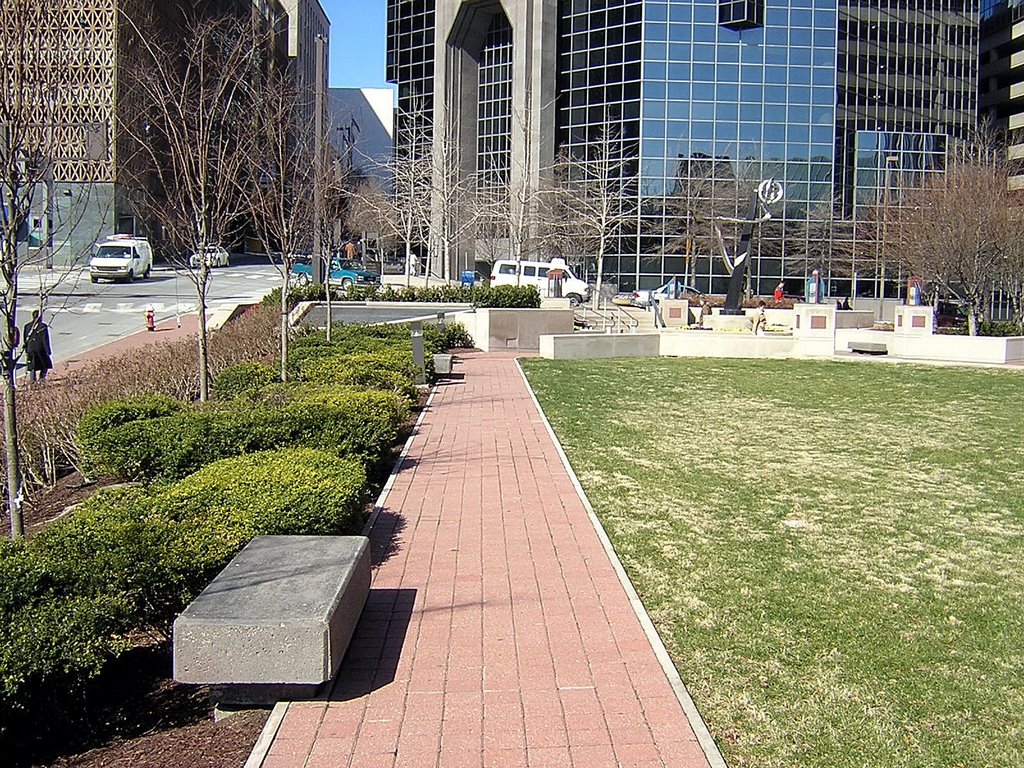
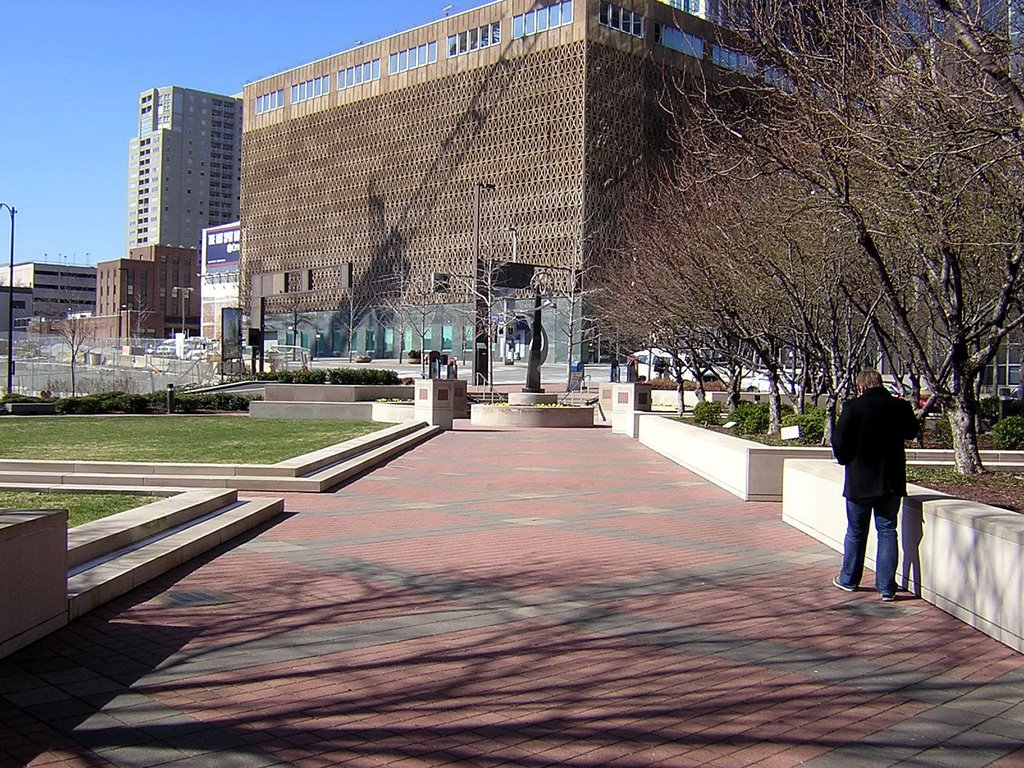
The northwest corner of the property is bathed in natural sunlight, and it is punctuated by a public art feature. The space has a variety of plants and trees accentuating long grassy lawns. A number of benches, low walls, and steps offer pedestrians places to sit, and along with the flora provide lots of "edges" where people can go and get some sense of out-of-the-way seclusion. The day I was there I saw no food vendors, but there is a large paved a walkway that runs from the corner plaza entrance to the BellSouth Building that could accommodate some food carts. There seems to be room on the lawns for a small number of café-like tables, although too many spread around the lawn might give the plaza a cluttered look. However, there is plenty of seating without tables so that people could tarry here for lunch if there was food readily available.

The aspects of this plaza that might hamper its attractiveness generally involve street accessibility, which is limited. The plaza is ringed by low walls and hedges with a small number of entry points. Save for the corner of Commerce and 4th, the plaza has the feel of being closed off from the street, which may or may not be a strong attractor for occupants of the Batman Building, but it would not seem to be a strong attractor for casual passers-by. The filmmakers said that one of the attractors of a space is in its allowance for people-watching. If the plaza is closed off from the street, it discourages people-watching. Another strike against this plaza is that seating is fixed and cannot be moved around to suit individuals or groups. They have to take what they can get. Finally, because the space is large-scale and without hidden interesting features (such as the sound of water flowing), I don't believe it would possess that mysterious aspect that makes pedestrians want to stop and explore the space.

Once you discover this space, it seems one of the more outstanding places to gather. However, you have to be intentional in order to find it. It is not easily stumbled upon.

Sunday, March 27, 2005

Too Young To Buy Paint?

A couple of weeks ago I was tuned to live coverage of the Metro Council meeting to watch them handle the bill prohibiting front yard fences that I touched on before. After happily witnessing the deferment of the bill, I stayed planted on the couch just to watch the other business they had to conduct.

My ears perked up when they got to the debate on a bill sponsored by Mike Jameson of Downtown-and-East Nashville to prohibit stores from selling spray paint to minors. I had heard of the bill in passing on the evening news, and I wanted to listen to why someone would advance such a farfetched notion for controlling graffiti.

If you read this blog on a regular basis, you will remember how much trouble the little angels in my neighborhood have been causing me personally and others more generally with gang-related graffiti. Despite my ever-stoked desire for Metro to be proactive in stopping the diminutive vandals, I remained unconvinced that stopping the sale of certain art supplies to those under 18 would work. It seemed to me to be well-intentioned, but desperate and misplaced; so, I didn't take the bill too seriously ...

...until I listened to all of the desperate and misplaced reasons that opponents gave for defeating the bill. In a paraphrased nutshell, they included:
  • "Who are we to call this graffiti vandalism? These kids might be budding artists who just need to be encouraged and trained to find different canvases on which to paint."
  • "It is impossible to legislate appropriate behavior for teens."
  • "We need to train and to teach children not to vandalize instead of making laws to restrict them."
  • "What will children in art classes do when they cannot go out and purchase supplies? This bill will punish unfairly teens in art classes."
  • "The bill will not stop graffiti because all the offending teenagers will need to do is ask an adult to purchase spray paint for them."
I could not believe how this bill stirred opponents to protest. I never took it seriously until I heard exactly how seriously they took it. I also was in disbelief that public servants would go to such unreasonable lengths to oppose a bill that probably only enjoyed marginal support by those outside affected communities.

Probably against their better intentions, the opponents of prohibiting sale to minors drove me firmly into the supporters' camp. The reasonableness of prohibiting the sale was made clear to me in the lack of reason of council members who rose against it. Here's why:
  • "Gangsta" graffiti obviously ain't art. I don't have an appreciation, let alone an understanding, of avant-garde art. I am hard pressed to comprehend the logic behind nailing a Barbie doll to a painted wooden shingle, framing it, and hanging it on a wall at Bongo Java with a sale price of hundreds of dollars. But I understand the difference between graffiti as an art form and graffiti as "gangsta" turf definition. No matter how naive one acts about the intentions of vandals, when one sees a group calling themselves "the Bloods" daily wearing red clothing, trying to intimidate neighbors, and using only red spray paint to claim their "hood" and to "R.I.P." their dead friends, one must conclude that what they are doing ain't art. Encouraging them to find a more suitable canvas might get one a bullet in the head.
  • It's ridiculous to claim that we cannot legislate appropriate behavior for teens. Nashville does it every Friday and Saturday that it enforces a curfew. Beyond that, the rule of law is legislating appropriate behavior for everyone. Do these council members really believe that we should stop writing laws?
  • If we cannot legislate appropriate behavior for teens, how could we possibly legislate training for them?
  • Kids in art classes who need spray paint will do what every other kid does when its time to buy supplies: haul their parents to the store with open billfolds to pay for the supplies.
  • Reasoning that adolescent vandals can still get spray paint by asking adults to buy it for them is like arguing that we should not have drinking age laws because kids can find an adult to purchase alcohol for them. I don't see very many council members advocating the repeal of prohibition of alcohol for minors.
In the end I did not hear one good reason for not prohibiting the sale of spray paint to minors. In fact, the reason that Councilman Jameson made for it sounded pretty good to me: it gives vendors who suspect foul play the power to tell teens that they are not authorized to sale spray paint to anyone under age. At least proponents of the bill are trying to lead on this issue; and that is the bill's most attractive feature to me, one of the many victims of vandalism. If opponents don't like it, then they need to pull their heads out of the sand on this issue and they need to find some means of leading us to a solution.

Thursday, July 26, 2007

Some Second Impressions of "Ghost Ballet"


This morning I attended the installation ceremony of "Ghost Ballet" on the Shelby Street Bridge overlooking the sculpture that is Nashville's first public art project. Among other speakers, Mayor Bill Purcell and the artist, Alice Aycock, addressed the decent-sized crowd sprawling on the bridge over Ghost Ballet.

The artist described the sculpture as a snapshot or a moment suspended in time appearing on the East Bank in contrast to the modern tendency to wipe the old away. She mentioned its symbolic connections to Nashville's past and its modes of transportation. But Ghost Ballet also refers to the future and to the human quest to "inject" ourselves into space.

She nodded to popular interpretations of the sculpture as a roller coaster and mentioned her own childhood memories of a Pittsburgh amusement park. Accordingly, the sculpture is meant to convey feelings of weightlessness. The irregularly-shaped, free-standing disk that sits on the ground below the statue stands for the Industrial Revolution. It is the "dynamo," according to Aycock that generated all of the other aspects symbolized in Ghost Ballet.

I was no less impres-sed by Ghost Ballet today than I was when I first saw it from Broadway. Each of the elements of the sculpture seem grounded in Nashville's history and yet some are broader and--in the case of the future--transcendent of the Nashvillian aspects. Even if the sculpture has a roller coaster quality to it, rather than garnering disdain from the masses, it ought to appeal to the "bread-and-circuses" mentality of the same. If art did not start a debate, then I guess it would not fit the label "public." This is a good piece to call our first public artwork.

Friday, May 08, 2009

Mayor Dean's Press Release on the Capital Budget, Which Includes the East Bank Adventure Park

Via Protect the Plan:
Mayor Karl Dean will file a $560 million capital spending plan with the Metro Council by noon tomorrow. The legislation will include a $110 million net reduction in government projects approved by past administrations and Councils, and new funds for projects related to the city’s priorities of education, public safety, economic development and quality of life.

It has been two years since the city has approved a capital spending plan, and this will be the first for my administration,” Dean said. “It is important, even during difficult economic times, for a city to invest in its infrastructure and facilities needed for our citizens. But given the current economic environment, it’s more important than ever for our investments to be made wisely and support our priorities and our community’s greatest needs.”

A complete list of the capital projects to be funded in the spending plan will accompany the legislation filed tomorrow, highlights include:

Education
· $156 million for schools, including $63 million in new projects with an emphasis on adding classrooms to replace portable buildings at elementary schools

Public Safety
· Over $30 million for public safety to include a new west police precinct, police DNA crime lab, planning for two new police precincts in the Southeast and Madison areas, a new fire station in the Southeast area, and the renovation of seven existing fire stations

Economic Development
· $30 million for riverfront redevelopment, including the Adventure Play Park, the NABRICO building and NABRICO gardens, the east bank River Lawn, a new east bank redevelopment district, and the First & Broadway Overlook, City Wharf and Pioneer Walk on the west bank
· Over $37 million for the Metropolitan Transit Authority, including $22 million new for infrastructure to develop Bus Rapid Transit, starting along the Gallatin Road corridor, and fleet replacement
· $10 million to support the development of the new Museum of African American Music, Art & Culture
· $500,000 for planning the 28th Avenue Connector between West and North Nashville

Quality of Life
· Nearly $60 million for public works projects, including $6.1 million for new and improved bikelanes and sidewalks
· $50 million in major stormwater projects to be funded by the stormwater fee to take effect on July 1
· Nearly $24 million for parks, greenways and community centers, including $3 million for greenway expansion, planning for a new joint community center and public health facility in the Southeast area, and over $5 million for the acquisition of three new parcels of park land in Madison, West Nashville and the Southeast area
· $5.2 million for a new public library in Goodlettsville


RELATED: CM Mike Jameson, who first began raising red flags about this, is "enormously grateful."

Saturday, December 31, 2011

Enclave's 7th Annual Best and Worst Metro Services

In last year's Best and Worst I offered some New Year's resolutions for each of the Metro Departments I covered. None of them were realized, so I won't even try this year. I did stay with last year's form of picking the 3 services whose activities got most of my blogging attention. I also continued the idea of tacking the rest of the mentionable departments after the big three.

Without further adieu, the best and worst of the services that are supposed to be of some benefit to us.

Metro Council
Surprisingly to me, there was a lot more good than expected from the council whose term ended with last August's elections. That council launched the nondiscrimination ordinance in the wake of the Belmont soccer coach controversy. That ordinance, destined to be blocked by the right-wing Tennessee General Assembly, prohibited Metro contractors from discriminating. Also good was the joining together of both council progressives and conservatives to stop Mayor Karl Dean's unilateral plan to demolish the racetrack after a huge, historic turnout to the public hearing. Not even Vice Mayor Diane Neighbors' draconian public hearing tactics could derail the results. To their credit, the council required any Fairgrounds redevelopment to include a bona fide, inclusive community planning process. Finally, CMs approved Mike Jameson to General Sessions Judge. Like I said, it surpassed my expectations.

On the other side, the council generally behaved like the cowed tools of Dean it has generally been. The Budget Committee followed the Mayor's budget hearing script, and they failed to properly review County Clerk John Arriola's inappropriate spending habits, which later blew up in the media, resulting in belated CM calls for Arriola's ouster. They also failed to do their due diligence on objectively filling a Criminal Court Clerk vacancy, instead approving the Mayor's hand-picked choice, Howard Gentry. Then there is the newly elected council, which looks like it will be more Dean-dependent than the previous council ever was. Having learned nothing from the Mayor's summer IQT debacle, the sheep herd moved to approve the Mayor's plan to allow LifePoint to pay no taxes for several years and reduced taxes up to 15 years in exchange for property that could have itself been incentive to relocate.

Noteworthy CM performances:

  • Emily Evans and Jason Holleman tried to bring back an equitable plan to remove cap on storm water run-off fees for businesses.
  • Jamie Hollin, who could plausibly qualify for Nashvillian of the Year, was the drum major for nondiscrimination legislation and struck a populist chord on the Fairgrounds preservation. He brought progressives and conservatives together in winning efforts, while being a gadfly for Mayor's Office and culture warriors alike. Any current CM who desires to be perceived as independent should look to Hollin.
  • Erica Gilmore expressed unqualified support for historic preservation of the Fehr School Building. She also took a leading role on the council's nondiscrimination ordinance. She finally put the African American Music, Art, and Culture back on the radar after being distracted by the Sulphur Dell ballpark concept.
  • Karen Bennett voted against nondiscrimination and then said she encouraged those who supported her vote not to take an online neighborhood poll on the nondiscrimination measure, even though the poll could be taken anonymously.
  • Jerry Maynard compared the Fairgrounds to crack houses and bristled when North Nashville talk show listeners called him the Mayor's "rubber stamp" on the air, prompting him to call them GOP "ringers". Also, Maynard had to scrub "lawyer" from his campaign website after it became clear that he was still suspended from practicing law.


Mayor's Office
The main feather in Karl Dean's cap had nothing to do with his re-election talking points to staged neighborhood meetings of "economic development, economic development, and economic development". It was signing the nondiscrimination ordinance over the protests of the local Chamber of Commerce and in spite of his past reticence to sign anything that regulated the "free" market. Sure: it seemed arbitrary and capricious given the story of his change of heart was a chance encounter with wealthy booster Mike Curb, but any time Karl Dean breaks from the Chamber it is beyond all doubt newsworthy and laudable. To his credit, Hizzoner also finally followed through on his longstanding promise to move the Metro Action Commission's main offices and utility bill support service to more accommodating facilities than Salemtown's old Fehr School.

And then there was the rest of the mess. Dean didn't visit Antioch after a February tornado, but he did carry on with a non-essential trip to Japan in spite of State Department warnings against non-essential travel. He announced a plan to reduce the size of North Nashville police force and to increase the size of the suburban force. The Mayor stuck to his plan to demolish the Fairgrounds Speedway despite mounting losses on Fairgrounds redevelopment and demonstrated public pressure against demolition. However, he never consulted the Fairgrounds staff for feedback before introducing his demolition plan. Obtained emails showed Dean staffers tried to exclude some preservationists from the public meeting process. When they were not trying to torpedo their Fairgrounds opponents, the closest Dean advisers accepted gifts of vacation lodging and other perks from a no-bid Metro contractor in violation of a 2008 executive order signed by Dean.

Meanwhile, the Mayor was expanding his staff. He hired former Bredenistas at prices that could have paid for more Metro services. He doubled his communications staff to "serve the needs of the media".  The hirings did not sit well with all, given that in 2011 less than 250 stormwater projects completed after 2 years and road maintenance and repair needs were lagging behind. The Mayor also cut back the concept of a green roof on his expensive new convention center to a small fraction of the structure to save money. In July the Mayor lost a jury decision and in December he lost the appeal, both of which guaranteed that the convention center budget was busted. Dean told the press in June that "our citizens" expressed "overwhelming support" for a new convention center, even though construction never enjoyed more than 37% support in polls; last year construction only got 26% support.

Dean, a politically connected lawyer besides being Mayor, plead ignorance on news that fellow Democrat Phil Bredesen had leveraged the transfer of millions of dollars in non-hockey-event sales from Metro coffers to the Nashville Predators hockey club. Dean raided funds designated for services to pay for streets, parks, libraries, and public safety in order to subsidize professional hockey in Nashville because he had to redirect tourist taxes earmarked for the Predators to construction of the Music City Center.  The Mayor's Office looked the other way while the Predators tried to extend a no-bid, noncompetitive contract with an NHL insider and while they lied about checking with other potential vendors. Finally on the sports front, Mayor Dean dropped $157,000 on a ballpark feasibility project, but he concluded in December that a new ballpark is a "luxury."

Karl Dean joined forces with GOP Governor Bill Haslam to offer the IQT company government subsidies, tossing 1,000 Canadians out of their jobs; because of their admitted failure to adequately vet IQT, they were shocked when the company declared it was not moving to Nashville. On the education front, the Mayor flung himself even deeper into privatizing, venture philanthropy trends in public education with Teach for America, charter school incubators, and "CEO Champions".  He earmarked $10 million for KIPP Academy (charter) while bona fide public school infrastruture continued to crumble.

As for his re-election, Dean supporters criticized any opponents who dared politicize the 2010 flood, while the Mayor held campaign events under the banner of "rising" from the 2010 flood. Shockingly, the Mayor's re-election also solicited journalists to join his "community steering committees".

Metro Nashville Public Schools
It is rather depressing, as a public school parent, to say that I found nothing good about MNPS this year. I wish I could find a half-full glass.

Director Jesse Register signed a letter with wealthy special interest group leaders from Nashville's Agenda to oppose the state's plan to streamline teacher evaluations. Charter school and innovation czar Alan Coverstone held a North Nashville "collaboration" and in private school fashion did not invite everyone with a stake in North Nashville schools. MNPS's advocacy partner Stand for Children gave subtle indications that some interpret as moving against teacher unions as other Stand organizations have done in other parts of the country. An embarrassing YouTube video appeared in June that showed the SFC CEO telling an audience that his organization used the best lobbyists in Illinois to jam proposals down the throats of teachers unions. SFC Nashville waged its own campaign by endorsing Karl Dean for Mayor, in spite of the apparent conflict of interest. While my kid's underfunded North Nashville school suffered for a lack of computers, a Boston charter school company was spending over $100,000 (stipend + benefits) on each of its twenty-something MNPS charter school founders.


The best and mostly worst of the rest in no particular order 

  • Metro Finance -- Rich Riebeling could not or would not project a cost for Fairgrounds demolition even though he was its most ardent advocate.
  • State Fair Board -- Emails showed that Buck Dozier lampooned a Fairgrounds redevelopment concept informed by the community and written by the Nashville Civic Design Center.
  • Convention Center Authority -- 10 months after CCA PR manager Holly McCall swore that the Music City Center budget would not go over budget, the Music City Center budget was blown by poor estimates on the value of land acquired.
  • Metro Water Services -- Scott Potter failed to respond to a West Nashville community leader who emailed her concerns about locating the West Nashville Police Precinct along the Richland Creek watershed. Only one community meeting was held on the matter after a number were promised to get feedback. And I learned some interesting information on vulnerabilities at Central Wastewater Treatment from a former security guard at MWS that makes me feel a lot more insecure.
  • Metro Health Department -- Cited Occupy Nashville for food health violations, then performed an about-face, telling the press that they should not have been cited.
  • Metro Police -- Stationed a not so inconspicuous van as "undercover dignitary protection" for former Bush official Donald Rumsfeld, who even after all of those years patronizing privatized black ops security companies can obviously no longer afford private protection.
  • Metro Night Court -- Magistrate Tom Nelson refuses THP request for arrest warrants on Occupy Nashville protesters, thusly defending their basic liberties.
  • Metro Planning Commission -- In Autumn, local company Yazoo Brewery teamed up with small Bells Bend farmers and produced their first line of beer made with locally grown hops, appropriately called "Bells Bend Preservation Ale". If it had not been for the Metro Planning Commission's narrow rejection of May Town Center, this buy-local project might not have happened. The rejection happened in 2010, but the ripples spread into the community this year.
  • Mayor's Office of Neighborhoods -- Played a Halloween trick on neighborhood association leaders by handing an alarm company all of the latter's contact info, which is now held by Metro under false pretenses.
  • Metro Historical Commission -- Kick-started the process to help Salemtown toward rezoning for the historic Fehr School building, a Civil Rights Movement monument.
  • Metro Planning Department -- Finally included a nondiscrimination provision on gender, gender identity and sexual orientations 2 years after Metro Council passed an ordinance requiring it and a few weeks after Mike Peden started emailing them, Megan Barry, and Jason Holleman about noncompliance.
  • Public Works -- Attempted to redesignate collector streets without any community input despite profound impact on pedestrian neighborhoods.
  • Davidson County Clerk -- John Arriola spent wads of public Benjamins on superfluous signs and SUV among other forms of malfesance.
  • MDHA -- Washington Post goes national with the agency's failure to start construction on low-income housing even after federal money was spent to buy the land and to build infrastructure.
  • Metro Legal -- Dismissed a spurious, stupid complaint by a supporter of Mayor Dean against Emily Evans after the supporter misconstrued a friendly chat as unfriendly.


Writing these each December becomes harder rather than easier. I keep looking for more progress in Metro, but it is a rare commodity.

Sunday, June 29, 2014

In Tennessee, innovation and corruption seem to go hand-in-hand

Recent visits from two notable figures, AOL co-founder Steve Case and Salon writer David Sirota, rendered two different takes on how we spend our money in Tennessee. Mr. Sirota cited a study that indicates that the Volunteer State is one of the more politically corrupt due to how it spends most of its revenues: on construction and police protection instead of on education, health, and welfare. The writer also mentioned Nashville's penchant for throwing our tax revenues at private corporations, which don't appear to find our city itself enough of a lure to decline to payola to stay put:

“Cities and counties in states with troubled political cultures demonstrate the greatest willingness to offer business development incentives.” And again, comparing Tennessee’s corruption with its economic development policies seems to confirm this.

According to the watchdog group Good Jobs First, Tennessee is at the top of the list of states offering so-called “megadeal” subsidies to corporations. Likewise, the Nashville City Paper reports that in the name of economic development, the city has been dramatically increasing its subsidies to corporations, including a $65 million outlay for a minor league baseball stadium.

During last December's ballpark debate when suggestions were made that Metro lessen the moral hazard of handing Nashville Sounds owners our revenues by making them more obligated for spending the money responsibly, the Mayor's minions on the Metro Council called it a "poison pill" that would kill the deal. I would add such false provocation to Mr. Sirota's list of indicators of political corruption in Tennessee.

The city's legislative branch expressed shaky ethics in defending Mayor Karl Dean (who has turned private subsidies into an art form) with its outrageous slurs about entirely reasonable requests concerning how public money is spent.

One council member defended the ballpark funding scheme by insinuating that she might retaliate in any future projects in other districts:

Erica Gilmore
If you think about the way I have supported you in the past, your different projects so that your particular districts can thrive and survive. And I think I've been good at doing that. So, I ask that you would support my district tonight, my community, not just for me but for Nashville. We have to make sure things are equal. We have to make sure all communities work, and before I have never stood up on big projects and talked about fiduciary responsibility, taxpayers money. We just trusted it in the past and now we have a question with it.

It is the height of councilmanic privilege to hold future votes over the heads of other CMs in order to push through a ballpark plan despite questions on how public money will be spent. It must have worked, because she did it again last February regarding a different proposal in her district:

Please know that in order for us to work together you have to support me, because if you bring something for your constituents you expect me to support you and you can't support me I can't do it as well.

For his part Mayor Karl Dean acts like it a badge of honor that Metro is making no money off the lucrative ballpark naming deal with First Tennessee Bank and that the only big ticket item Sounds owners are paying for without government assistance is the guitar-shaped scoreboard. No wonder that Hizzoner wanted to push it through with as little public input as possible; Nashville ends up on the short end of the financial stick at almost every point.

Mr. Sirota is on to something in our state. His observations also provide the political backdrop for Steve Case's visit and comments about Nashville's startup businesses. Discussions about startups in Nashville seem to occur in echo chambers at the expense of evidence that the startup industry is contracting. So, Mr. Case's appearance may be an attempt to shore things up.

The Nashville Business Journal reported:

Looking forward, Case said, that entrepreneurial spirit will be needed to continue growing, competing globally and creating jobs.

“If we’re going to create jobs, we have to back our startups,” Case said.

And those startups can’t just be emerging from Silicon Valley, he added. As technology enters its “third wave” and focuses on integrating the Internet into myriad processes – health care, transportation, etc. – other regions of the country with experience in those sectors should emerge as leaders.

For Nashville, Case said, that will mean seizing the opportunity to remain the biggest innovator in the world of health care.

NBJ did not elaborate on what Mr. Case meant by "we have to back our startups". What that has meant in Nashville under Mayor Dean is kicking in corporate welfare for private businesses, even as public services suffer under his budget knife.

I worry about Mr. Case's exhortation to fund disruptive innovation in health care. Tennessee already flirts with corruption in that it spends less public revenue on access to health care than on subsidizing private business. Encouraging technological expansion in health care is not the same as investing public dollars to expand broader access. Dumping money unregulated into the health care industry simply translates to writing executives blank checks to do anything they want. Startup businesses are not beholden to anyone but themselves and the corporations to whom they may or may not eventually sell out to.

Unchecked innovation will only encourage more corruption in Tennessee regardless of how redundantly stylish it has become for techies to claim they "make the world a better place".

Mr. Sirota deftly rebuffed claims that on-the-dole innovation leads to greater economic development:

Do those subsidies result in job-creating technology and innovation hubs? While many locales ramping up their subsidies certainly hope so, the jury is still out — and that’s being generous. Indeed, there’s plenty of evidence that subsidies do not create the economic development their boosters promise, and instead they merely cannibalize already-existing economies. Meanwhile, a lot of those subsidies end up being awarded to politically connected firms, calling into question whether they are really designed with any kind of coherent economic development plan in mind.

So, the growth that happens here is not caused by the disruptions prompted by government redistribution. The growth would have happened somewhere. All the corporate subsidies do is favor some industries over others and cement political influence and cronyism.

A paycheck
One more note of irony to close this out: Mr. Case's visit was hosted by Nashville's Entrepreneur Center, which is housed in the refurbished Trolley Barns on Rolling Mill Hill. Those Trolley Barns are publicly owned (by MDHA, which bought the property for $10 from the county in 2006). The barns were built as part of the Works Progress Administration, the largest New Deal program that pulled our country out of the Great Depression, not by privatizing and outsourcing the work, but by the government directly hiring and paying people to build. Whenever governments promote job creation nowadays, they come across as a faint shadow of the bold New Deal. Likewise, Mr. Case's chatter about startups providing jobs is a negligible projection of what the government could actually do free from the networks of crony capitalism that fund so many political campaigns.

The political corruption that we see rampant in Tennessee and in Nashville with the giveaways is neither necessary nor inevitable, but until there is tectonic shift in political culture here, the corruption will continue.

Sunday, February 12, 2012

Jefferson Street's deferred progress finally coming back around

Buzz about a possible ballpark at Sulphur Dell had eclipsed promotion of the long-awaited National Museum of African American Music, and it seemed to push aside Jefferson Street's Gateway to Heritage public space development. Now the latter is starting to get media play with excuses made for the 3-year delay include that multiple government agencies had to analyze and approve:


While not ideal public recreation space, areas under highway overpasses can be made hospitable. Here are some photos I made of greenways and public art under and on overpasses in the Deep Ellum section of Dallas, TX.


There was never a good reason for any government agencies to allow government-owned properties along the Jefferson Street corridor to fall into the blight that it did. And our community is long past due for the improvements that would have likely sailed through in less time for more affluent parts of Nashville.

Thursday, June 29, 2006

Charlie Tygard's Broadside Against the Arts

Council member Charlie Tygard told the Nashville City Paper that, because he could not get some department cuts that he wanted, he went after Arts Commission. That was popular with the conservative horde in Council chambers, who no doubt see Piss Christ in every statue that doesn't resemble Billy Graham and a cross. Council responded by slashing $258,400 from Arts, sending it instead to the Sheriff's Office. The spirit of Fate Thomas was no doubt lurking around the chambers near Tygard's corner when he hatched that misdirection. An extra cheap jail clean-up detail or two make a few constituents happy; meanwhile Nashville's relative poverty of public art will continue.

Tygard also raided the Mayor's Office and leveraged $50,000 so that Council members could build one single Habitat for Humanity home and feel closer. Now, I'm not down on Habitat. They are an effective private charity that makes a real difference in people's lives. But Tygard's primary intentions are not to build a house for a needy family; his primary intentions are to sponsor a bonding event for current Council members. The buzz is that the event is also self-promotional: Tygard is running for Vice Mayor. So, why raid the Mayor's budget so that Charlie Tygard can promote a Kumbaya Council and his own electability? Seems to me that he should have worked for that $50,000 the old fashioned way: by lobbying his cohort for pledges of private donations, which actually may be ethically done in back rooms. Instead, Tygard lazily used Council prerogative to channel public money to this private charity. This may end up costing those of us who benefit from Metro services like the Mayor's Office of Neighborhoods.

Council member Erik Cole called Tygard's amendment and the conservative horde to the carpet:
I don't vote on the budget to make a political statement about who's in the Mayor's office.
No, Mr. Cole, but apparently the conservatives do. Though in the final analysis, Charlie Tygard's single Habitat House will amount to nothing but ground clutter compared to a Purcell legacy that leaves us sidewalks, community centers, and a beautiful downtown public square.

Monday, May 11, 2009

Tennessee State Mutual Admiration Society

We did not go to meeting last week in Germantown hosted by Senator Thelma Harper to preview plans for what her office is calling the the "Avenue of the Arts," along of a four-block stretch of Jefferson Street (shouldn't it be dubbed more accurately, "Street of the Arts"?). The meeting was designed to update "Germantown" on the Tennessee State Library & Archives, Tennessee State Museum, Museum of African American Music, Art, and Culture, and Bicentennial Mall State Park.

The invitation arrived a couple of days before the event and I did not pay much attention because the big title ("What's Happening in Germantown!") looked like the dozens of real estate advertisements we have received this year. So, we did not go.

After talking to a Salemtown neighbor who went, I'm glad that I did not go. I needed an evening relatively free from bunkum. Reportedly, Senator Harper and State Parks Commissioner Jim Fyke came across as self-congratulatory about how "fast" the state moved to install emergency call boxes at Bicentennial Mall State Park after a Germantown resident was raped there in September 2007. If by "fast" they mean "one year," then I fear to imagine what "slow" would have looked like. I completely fail to understand how Jim Fyke is due all of the praise, given that he derided my own suggestion of call boxes during a phone call a mere two months after the horrible event.

However, to the point of christening Jeff Street "Avenue of the Arts," I would raise the question of whether that name has already been taken by a more north-south artery, including a 2002 Civic Design Center proposed extension across Jeff Street on 5th Avenue into Salemtown that would incorporate student-created street mosaics and "pocket" parks with public art.

Friday, May 06, 2011

Ready to buy that Sulphur Dell ballpark idea? Nashville's neighbor to the north has a cautionary tale about new ballparks

Besides getting his open space plan back on track recently, another reason Mayor Karl Dean is paying part-timer and former Bredesenista Jim Fyke $60,000 is to recreate the appearance of progress on a proposed baseball field. Hence, this week's news from Southcomm's Field-of-Dreams reporter Joey Garrison that Mr. Fyke is leading a feasibility study that will explore possible sites in Riverfront Park, in SoBro, on the East Bank, and finally, at Sulphur Dell in the North End.

Word on the street is that the Mayor's Office is inclined toward Sulphur Dell and has been instrumental in fostering support in council and among some neighborhood leaders for it. Still unknown is whether Karl Dean's rumored support for the Sulphur Dell option is authentic or is a tactical position designed to leverage Nashville Sounds ownership either to make concessions or to quit pursuit of a new ballpark altogether. I'm hearing that the old thermal site at Riverfront is off the table because of preferences of wealthy donors for an amphitheater there.

Tuesday, December 05, 2006

Keeping Tabs on the Council's On-Going Conversion of Tax Dollars to Charitable Donations

With another Metro Council Meeting upon us on Tuesday night, it is time for the third Enclave report on how this council is electing to spend a $1.95 million windfall from uncollected property taxes this year that they earmarked for their own discretionary spending. And by "discretionary spending" they don't seem to mean adding funds to government services to address public need. So far, 100% of those tax dollars have gone to subsidize private charities close to council members' hearts.

This week's council agenda extends the conversion of property tax dollars to charitable donations with 5 "Reserve Council Infrastructure Program" resolutions up for council vote:
Our watch to see if any of the $1.95 million actually goes to public programs continues.

Despite glaring chances to pave some alleys or to solve a few water runoff problems or to refurbish the worst public parks in Nashville, council members continue to be set on playing philanthropists, pitching public money at private non-profits rather than at actual Metro infrastructure. Metro Water should have a bunker and more than one security guard to protect those dangerous chlorine gas tanker cars currently sitting out in the open on the North End, so why are these leaders not so allocating these tax dollars to protect us from the calamity of a chemical spill? Why can't they pool a couple or three million to build Charlie Tygard the fire station he says he needs (even as he's spending his own allocated funds on private sports groups and on private swimming pool upgrades)?

Why? Because it would probably get called "massive government expansion" by those who seem to fancy a world of declining municipal services as subsidies for private charities increase. Why is it perfectly fine to criticize spending on government programs that pave roads or build fire stations, but not to criticize the frittering away of uncollected property taxes on private charities, based on nothing but councilmanic discretion?