Saturday, October 22, 2005

Indecent Exposure

I'm tired of yokels pissing in our alley. I've decided to start openly taking their pictures with hopes of discouraging them or at least getting an indecent exposure charge to stick. I'm probably taking these surveillance shots at some personal risk, but I'm frankly fed up with the urinators.

The pictures you see here are of a hunter green Chevrolet Yukon stopping just off of Hume around 4:30 today so that the African American driver can relieve himself when there are perfectly good gas station urinals just a few blocks away. He also littered before he left.

The first pic was taken in mid-piss. The second one as the driver backs out of the alley upon seeing me appear with my camera. The third one as he speeds away; tried to get a clear shot of the license plate, but it didn't turn out well.


Neighborhood Conference Today

I am about to head over to the Mayor's Conference on Neighborhoods this morning. The emphasis this year is on security and Chief Ronal Serpas is the keynote speaker. Chief Serpas may not be in a great mood given the story on his $4,600 desk/credenza in this morning's Tennessean. The reporters didn't bother to give us a standard or minimal cost of office furnishings, but $4,600 is more than I would pay for a work desk. But the difference between $4,600 and whatever the Tennessean's ideal cost for a desk would be would probably not pay to keep the neighborhood watch program up and running.

The reporters also quote Ben Cunningham, who was previously an anti-revenue lobbyist with Tennessee Tax Revolt. Just out of curiousity, how does one move from being an anti-revenue lobbyist to becoming an "ethics activist"? Is it is simple as the shift from one political hot potato du jour to the next? Shall we call it "niche stalking"?

Thursday, October 20, 2005

The Social Construction of Rurality II

Little did I know, when I referred you to an NYTimes article earlier this week on the hamletification of rural parts south of Atlanta, that Christine Kreyling over at the Nashville Scene was about to publish her own article yesterday on a possible New Urbanism trend in Bells Bend and the seemingly slim prospect of "clusters," hamlets, and greenways being developed there.

Worth a read.

Farmers Market Face Lift?

Re-make the Market? We'll see.

Here's a morsel to add to the information mix: Mark Kerske of Gardens of Babylon is said to be vying for space for a health and holistic foods market and cafe at Farmers Market.

On a related note: the Farmers Market Harvest Festival is this Saturday afternoon. According to organizers it includes bluegrass music, a pumpkin painting center, food and crafts gallery, cooking, pumpkin carving, decorating workshops, and an apple dessert bake-off contest.

Wednesday, October 19, 2005

Support This 6th Avenue Zoning Change Request

The Metro Planning Department sent out notice of a zoning public hearing for a request made by property owners Ron McClaron, Arthur Yokley, Bradley Williams, Brian Courtney, and Moss Investment Partners to change zoning of 5 properties lying on the west side of 6th Avenue just south of Garfield St. (1623, 1627, 1631, 1633, and 1635) from R6 zoning to MUN zoning. R6 zoning is intended for single-family dwellings and duplexes. MUN zoning is "Mixed Used Neighborhood," and is intended for a low intensity mixture of residential, retail, and office uses.

As I have said before, MUN is the more restrictive zoning that requires that buildings come up to the sidewalk and that all parking be in back off of the alley. As such, it is more consistent with the urban and pedestrian character of the North End neighborhoods. It's great to see owners and developers pursuing more restrictive rather than less restrictive zoning. If you dropped by the Salemtown Neighbors booth at Oktoberfest, then you probably saw the attractive preliminary drawings for this development, which is to be called "Salemtown Gardens." So, I think this zoning change request is worthy of support. Residents need to encourage these kinds of new builds.

The public hearing before the Planning Commission is scheduled for Thursday, October 27, 2005 at 4:00 p.m. in the Howard Office Building Auditorium on 700 2nd Ave., South. The Metro Council makes the final decision to approve or disapprove this request based on Commission recommendations.

Will Java Ever Have A North Face Beyond Kijiji?

  • I had a chance to chat this morning with Bob Bernstein a bit while I was waiting to pick up a latte and he was waiting for his breakfast over at Bongo East. I asked him again what the chances are of him starting a coffee place on the North End. He told me that he had been approached by folks in Germantown about it, but that there was not much brewing, because real estate prices in Germantown are skyrocketing. Most of the discussion of a coffee place going in at Morgan Park Place seems to be coming more from developers end. It's also not clear that one will be going in at Werthan. I mentioned, as I have in the past, the possibility of grabbing a warehouse over in East Germantown. Bob told me that he is now interested in more than just a storage facility for the coffee if he can find a good arrangement to start a shop. That gave me a chance to mention Salemtown to him. I told him that Salemtown's real estate prices are still lower than Germantown's, although they are probably shooting up at a faster rate than Germantown's ever have. He asked me, "Where is Salemtown?"


  • On a side note, Bob confirmed news that I had previously heard that Portland Brews is going to open a shop on the East End.


  • On another side note, Bob and his wife are expecting a baby! A new heir to the empire, no doubt.

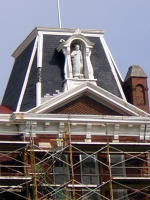
Gothic School Graces Jones-Buena Vista Neighborhood


Tuesday, October 18, 2005

I Can't Believe This Guy Is My Councilman

When comedian Jon Lovitz was with the Saturday Night Live troupe in the late '80's, he did a dead-on impression of Michael Dukakis facing George Bush, Sr. (played by Dana Carvey) in the presidential debates. After one of Carvey's skillful imitations of Poppy Bush, Lovitz as Dukakis looks straight into the camera and says, "I can't believe I'm losing to this guy."

When I continue to read Ludye Wallace's silly statements in the press justifying the irresponsible actions of our Metro Council, my only response is one similar to Lovitz's. I can't believe that Ludye is my councilman. I can't believe that this is our Council.

Ludye's latest asinine aphorism--covered by the Tennessean and Salem's Lots--is: "If it took a couple of years to put together, it might take us a couple years. You see how we operate in the city council." I interpret that to mean: "Despite shameful government ethics problems from Nashville to Washington, integrity in public service is not an urgent or pressing matter and the Metro Council is going to take its own sweet time to mix in the necessary amount of water to dilute standards that might otherwise restore the public trust in our elected officials. That's just how we are. Deal with it."

I won't be watching Council tonight. I cannot stomach the vacuum of leadership and integrity on this issue; and I don't care to listen to Council members like Ronnie Greer whine that adhering to standards is just too hard. Somebody else will just have to tell me what happens.

Monday, October 17, 2005

Where is Salemtown?

See for yourself by scrolling down to the North End Map that I have placed at the foot of this blog. You'll also be able to see where other North End neighborhoods are. The Metro Planning Department generously provided the map.

Ready For The Next Round Of Reverberating Katrina Body Blows? This Week They're Coming From Congressional Republicans.

The arch-conservatives in the Republican Party, lead by an outfit called the "Republican Study Committee," is set to hack and slash domestic programs up to $50 billion in order to pay for Katrina relief. Pushed by the RSC, Congressional Republicans are now moving to make massive cuts to Medicaid and food stamps. They are also posturing themselves to make wholesale, across-the-board cuts to other domestic programs. If I were taking odds, I would bet that Salemtown's Community Block Grant gets hit hard by the rightwing gutting of domestic programs if the arch-conservatives succeed. At the same time, they are considering cutting $70 billion in taxes for the rich.

This is simply a matter of taking from programs that support the more vulnerable in society and our local communities to give to New Orleans because Congress failed a long time ago to front the money to make the Big Easy's levees safer. So, Republicans are now making up by taking revenues from local communities to give to a single local community, while cutting the taxes of the rich.

If you thought higher gas and utility prices were the only cascading effects of Katrina, just wait until the Republican habit of raising revenues for the rich and sticking it to everybody else gets rolling. Their brightest idea in Katrina's aftermath seems to be to divide and conquer.

Spring Hill Has Become Dystopia

Looks like the Sunday-Sabbath Christians are lording it over everybody else in Spring Hill. It's not enough that the Spring Hill Taliban are not being very biblical (the Bible puts Sabbath on Saturday), but they are also making home repair projects on Sundays illegal because they think everybody should be coerced to worship their Sunday-Sabbath god.

That's produced a real quandary down in suburbia. Wouldn't it be interesting if the Aldermen passed an exception for non-commercial construction? Is it really biblical to require commercial construction to rest on Sunday, but to allow families to toil on construction projects on their homes to heart's content? More importantly, is it legal? I smell grounds for a lawsuit.

Either way, it looks like there is a totally different price to pay in Dystopia in exchange for owing no property taxes.

Nomination

Word came last week from the Mayor's Office that I have been nominated to receive the "Neighbor of the Year" award during the Celebrating Neighborhoods Conference on Saturday.

I don't know who made that nomination, but I would like to extend my thoroughly surprised gratitude here if that party happens to read Enclave.

Sunday, October 16, 2005

World Series Is Returning To Sweet Home Chicago!

Congrats to the White Sox, who just eliminated the "Los Angeles Angels of Anaheim." The Sox are much more deserving than the Cubs to host the World Series in the Windy City. The South Side is without a doubt "the baddest part of town."

As for the "Los Angeles Angels of Anaheim": now, there's a floating signifier.

The Social Construction Of Rurality

University of Chicago professor Jean Bethke Elshtain once referred to the city as a "floating signifier." Cities have lost their classical association with place and power, becoming instead symbols and gestures that we use to convey meaning to one another. Reading this morning's Real Estate section of the New York Times, I was struck by the realization that country life is no less a floating signifier than the city.

It seems that south of Atlanta, folks are trying to fight spreading "urban sprawl" (a.k.a., suburbia, which itself has never had much meaning to convey anyway) by buying up land and building what they consider small rural townships. But these townships are not the Mayberrys or Pixleys popularized in the more pastoral television reruns; they only exhibit loose and detached agrarian molds.

Rather than residents being separated by great distances, but held together by county seats or small town squares, these new ruralities exhibit the density of classic urban neighborhoods even as they are "tucked into a wide expanse of woodland, meadows and fields, laced with trails." These new "hamlets" do not seem driven by classical agricultural economic models; instead, the Times piece indicates that the economy is almost exclusively service-based. The article also suggests that the ruralities serve primarily as weekend retreats for some of Atlanta's city dwellers. One such retreater told the Times that he enjoys "the whole idea of living on a farm without having to do farm work." Farm life has indeed become a floating signifier giving ruralities an escapist and an environmentalist meaning.

I finished the article wondering whether these small townships are actually just the next wave of sprawl; a kind of sprawl-against-sprawl; the next outermost concentric wave of development caused by the splashes of suburbia and exurbia and the logical extension of the metropolitan idea.

Gardens Gets Landscaping Contracts, Including Morgan Park Place

Mark Kerske, owner of Gardens of Babylon at the Farmers Market, told me this weekend that he has been awarded the Morgan Park Place landscaping contract as well as the landscaping contract over in East Nashville at the new Martin Corner development.

This is great news and very well deserved. Congrats to our friends at Gardens of Babylon!

Further Evidence That That The Majority Of Metro Council Members Does Not Care A Lick About Integrity

Yesterday, and most shamefully, only 9 of 38 Council members showed up for the requested session on the Ethic Task Force recommendations.

Where the hell were Charlie Tygard and Ronnie Greer, both of whom have delayed and resisted ethics reform in Council loud and long?! Where the hell was Mr. No-Tax-Pledge Jim Gotto?! Couldn't Michael Craddock pull himself away from his Old-Buildings-Suck Protest long enough to get more information on the ethics bill?! Where the hell was my own Councilmember Ludye Wallace?!

This is just another example of how there are only a few Council members who are worth their salt this year--Jameson, Briley, Hausser immediately come to mind. A goodly number of the rest seem to be just taking up space meant for more qualified public servants.

Saturday, October 15, 2005

A Couple Of Traces Of Baseball In Late 19th Century Nashville

This afternoon I spent some time in the Nashville Room of the Main Library reading some 1881 editions of the Nashville Banner. I found the following paragraphs with regard to our national pastime.

From Monday, July 18 edition:

Baseball.

The members of the Nashville Red Stocking Baseball Club challenge any baseball organization in the State to play a match game of baseball, at a time and place to be designated by the captains of the respective clubs.

I found no evidence that the Red Stocking Club ever got a response, but, according to the Monday, September 5 edition, a couple of other teams saw some action in North Nashville:

Base Ball.

Friday afternoon the A. K. Wards and Rock City clubs crossed lances on Sulphur Spring bottom [near what is today 4th and 5th Avenues and Jackson St.], in a game of base ball. Over two thousand persons witnessed the spirited contest, Mr. Enoch Phillips acting as umpire, with that masterly skill for which he is celebrated. As an evidence of the sharp play we refer to the score, which was as follows: A. K. Wards, 26; Rock Citys, 24.

Besides sensing the sheer poignancy of baseball's longevity in Nashville, I was impressed that the baseball score in the latter paragraph was more like a football score and that the ump was "celebrated."

The Strangest Dog Act I've Ever Witnessed

I promise not to make a habit of filling this blog with inane anecdotes about my dog, Dix; but I am totally flabbergasted by some odd behavior, and I wanted to share just in case some canine whisperer out there might have insight to share.

We were in the backyard breaking in some new dog toys and all of the sudden she got that "got-to-take-a-dump" look and started circling and sniffing for a place to squat. That's not the strange part, because she regularly needs to go. I was proud of her because she stopped circling for a second, looked at me sitting in my deck chair for a cue, which came back to her as, "Dix! Potty!," while pointing toward a back fence corner, which is where we are training her to deposit her little care packages for maggots.

She high-tailed it fleet-footed back to her customary dumping ground and did her business. I was so proud that I did not for once have to lead her back that I decided to feed her a dog treat, which she gets sometimes when she trains well. When she saw me get the treat, she flew back across the yard to me and took it. Still not the strange part.

She laid down like she was going to commence to crunching it. But all of the sudden, she hopped up, treat in mouth, wheeled toward a tree and started digging a small hole between two biceps-shaped roots. When I scolded her about the hole, she dropped the bone-shaped treat in the cavity and started raking leaves and dirt over it with her muzzle. That was the strange part to me. While I've seen dogs bury bones, I've never seen them bury dog food (which will more than likely end up as squirrel food by morning).

Friday, October 14, 2005

Should The Rights To Styles of Historic Neighborhood Signs Be Reserved?

← East End “Historic” Sign


North End “Historic” Sign →


Perhaps some neighborhoods should find other forms of flattery besides imitation when it comes to those decorative neighborhood signs that are popping up around various city thoroughfares. The very attractive neighborhood signs scattered about the Historic East End has been copied in at least one other neighborhood on the North End. Actually, there is only one sign on the North End that is the identical match of the artistic East End signs: it is standing on the corner of 10th Ave. and Garfield and it reads "Historic Buena Vista School" on one side and "10th Avenue North" on the other side.

One of the things we discussed (at a very preliminary level) at the CAC meeting this past Tuesday was the possibility of funding decorative neighborhood signs as other neighborhoods like the East End and Edgefield have. When I pointed out that another North End neighborhood seems to have copied the East End, the community planner told the group that the single North End sign was controversial because the person (artist?) who created the East End signs has reserved rights on them.

Now I can understand a trademark for a title like "Historic East End" that goes on the signs, but I have some question as to whether the style and materials of the East End signs are themselves trademarked. There is no trademark notice on the East End signs. I can find no evidence of a sign trademark on the Historic East End website. Besides, trademarking a style of sign would be sort of like reserving rights to a wrought iron fence or the gothic cut of pickets in a stockade fence, would it not? If someone connected with Historic Buena Vista school was able to have a sign created by professionals that looks almost exactly like the East End signs, wouldn't it stand to reason that such a sign was available on the open market?

Copying the style of East End's signs may be bad form, but is it really illegal?

"You Have To Change The Wind"

One of the most important moments in the development of my political conscience was reading several articles in 1982 on the covert war in Nicaragua in Sojourners magazine. Sojourners, a progressive evangelical Christian magazine edited by Jim Wallis, castigated the Reagan administration for fighting the development of democracy in Nicaragua. However, it was no less forthright in its criticism of Democratic President Jimmy Carter for starting the covert war against Nicaraguans who had deposed the brutal Somoza regime.

Last night over at Vanderbilt, I joined a standing room only crowd to hear Jim Wallis once again criticizing both the political right and left in this country for getting both democracy and faith all wrong. Wallis told the group that Christians--along with other people of faith and like-minded people of no faith--should not simply work together on changing the election of government officials who merely stick their fingers up to see which way political wind is blowing. Instead, he said, "You have to change the wind." Wallis called upon the group to focus more on building a social movement--already begun in the wake of the 2004 election, the Iraq War, and Katrina's aftermath--in which faith has a place for political expression, but in which faith also disciplines itself with democracy and inclusion.

He contrasted that more chastened role of faith in politics to the political rightwing, which he claims created and mobilized the religious rightwing to gain control of our government. Wallis told his audience that religious rightwingers have it wrong as they attempt to portray Jesus as "pro-rich, pro-war, and pro-America." He also contrasted a chastened faith to the political leftwing, which he claims does not create any place for people of faith, not even progressive people of faith. He told a story of how a young gay man told him at one book-signing that it was easier for him to come out of the closet as a homosexual in America than it was for him to come out as a person of faith in the Democratic Party.

Wallis told his audience that he is unapologetically evangelical and unapologetically progressive, and that people in this new growing social movement need to be as unpredictable to both the press and the partisan politicians. There is much more common ground, for instance, on the seemingly divisive issues of abortion and gay marriage among evangelicals and progressives than partisan groups allow, according to Wallis.

Almost a quarter of a century after I first read Wallis's Sojourners magazine, I can see that he is still standing up to both sides of the political spectrum from a uniquely Christian perspective that remains attractive to many Christians and non-Christians alike.

Bedecoed On The North End: Cool Elements On School On 9th


Wednesday, October 12, 2005

Good Riddance, John Henry Hale. You'll Hardly Be Missed.

They're finally coming down in the neighborhood around Marathon Village. John Henry Hale was originally intended--when it were built in the middle of the last century--as temporary public housing. It turned into a awful permanent solution to dealing with poverty.

Thank goodness for Hope VI. It's going to lead to the revitalization of the Marathon Village neighborhood. It's a shame that the Bush Administration and the Republican-controlled Congress have slashed Hope VI to the point that this development is probably going to be the last we see for some time here in Nashville. There are several other housing projects that still need to be demolished around the city to make way for single family homes and duplexes and to provide opportunities for a better life free of crime and trash for neighbors of all income levels.

Tuesday, October 11, 2005

October Salemtown Citizen Advisory Committee Meeting Highlights

Tonight's CAC meeting was poorly attended. We had just enough for a quorum plus a few alternates. The group agreed once again to defer the election of officers to the next meeting, because we were not prepared to vote; no one was prepared to step up to run.

MDHA planner Linda Howard showed a PowerPoint presentation with examples of various projects on which CACs from other neighborhoods chose to spend their block grants. That was followed by small group discussions on what members saw as the strengths and weaknesses of Salemtown.

Looks like we will be getting down to brass tacks at the November 8 meeting, when we will be discussing ideas for community projects that could be funded.

The Mystery House At 10th Ave. & Garfield

Can you make out what the cornerstone says?


On Sunday, we wandered around near the Jones Buena Vista neighborhood, which is just northwest of Cheatham Place. Some of the houses along 10th Ave., North there are just as attractive as any in Germantown or Salemtown.

We stopped at the corner of 10th & Garfield near the spot where I-65 crops 10th, because I noticed a large comely building, which looked to be one of the more historic structures in the neighborhood.

I was struck by two things. On one side of the building stands a metal tower with a rusting old school or church bell.

But I was mostly interested in the cornerstone, whose weathered original message has been defaced and then obscured by cement troweled into the letters. Someone sadly intended to mar the words to posterity. I think I have been able to figure out what a good portion of the cornerstone originally read:

DAY NURSERY
ERECTED BY THE
[unreadable word] MISSION
1882

I welcome anyone else's interpretation of the whole 1882 message of the stone.

This is what I do know about the building: it currently houses Christ Temple North. I stopped and spoke with some of the parishioners on Sunday after their service. The ones I talked to were not sure how the cornerstone ended up as it did nor what exactly it read. They also told me that the bell pre-dates their congregation and that they do not use it. They also told me that Cofer's Chapel (a Freewill Baptist congregation currently located on Franklin Road) occupied the building before they did.

That last fact is confirmed in John Connelly's book on North Nashville. Connelly reports that Cofer's Chapel moved, after 45 years in the Buena Vista location, to King's Lane and Clarksville Highway in 1952 (which would have made them the occupants since 1907). Connelly also writes that one of the reasons that Cofer's Chapel moved was that the building had not been designed to be a church. Before 1907 it had been "Polk Avenue Day Home," one of Nashville's first homes for children of working mothers (Connelly, p. 154).

I'd like to track down some information that would solve the mystery of the unnamed owners of the Day Nursery, and how that institution served the neighborhood in its day. I went to the Nashville Room in the main library yesterday to look for information on it, but even with the help of the librarian, we could not find anything on "Polk Avenue Day Home," and very little on Cofer's Chapel before its move to Franklin Road. I'm going to have to dig through some turn-of-the-century newsprint and hope I get lucky.

Sunday, October 09, 2005

One Of The Warts On The History Of North Nashville

As I mentioned before, I recently read John L. Connelly's book, "North Nashville and Germantown." It is an adequate source for getting some historical background of the German and Swiss communities who lived, worked, and built the North End for a few decades before and after the beginning of the 20th Century.

It has its limitations. It is more like a scrapbook for the older aristocratic families than it is a strongly historical treatment of the North End. That makes some sense, given the date of its publication: 1982, just after Oktoberfest and Germantown's gentrification got off the ground and just after old North High School closed. As such, Connelly's book is more of a nostalgic memorial than it is a critical look at Germantown or "Butchertown" (as it was more popularly known one hundred years ago), which encompassed many more blocks north and west of the current Historic Germantown neighborhood. There are whole chapters where Connelly literally cuts and pastes newspaper clippings of community events rather than re-writing them into a narrative.

Perhaps its greatest limitation for me, a resident living in what was once the heart of the old Butchertown, is Connelly's blind eye to the issues of race. Aside from a handful of references, Connelly basically ignores racial currents even as he underscores the strong Euro-ethnic identity of Butchertown and its erosion by two World Wars against Germany and by the advent of suburbanization and white flight. (Connelly also glosses over class dynamics in North Nashville, but that's a subject for another post).

But the one time that Connelly does engage racial tensions in North Nashville, his account conveys, even if inductively, an atrocious picture of the locals about whom Connelly generally waxes nostalgic. It is what I consider one of the warts on the Germantown heritage.
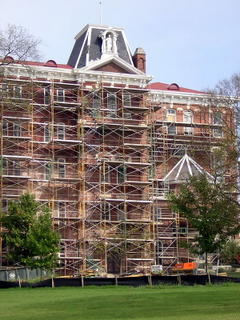
According to Connelly--again mostly lifting the account from a Nashville Banner article of the time--in 1923 St. Cecilia Academy (which was originally located in North Nashville; the building still stands and is pictured here) proposed to move elsewhere and sell the property to a "local Negro theological seminary." The Banner piece quoted by Connelly stated that 150 property owners in North Nashville held a mass-meeting at St. Cecilia to discourage the sale. Organizers of that meeting, according to the Banner,
described North Nashville as a high class residential section and expressed the cooperation of the North Nashville Improvement Association to the authorities of St. Cecilia in any movement looking to the prevention of the sale of this property to any parties not considered desirable to the citizens of that community. [p. 151]
Connelly says very little about this event and only places it within the post-World War I context of the German community in decline. In my opinion, within such a context and without clarification, his relation of the prevention of the sale of St. Cecilia's to black leadership could reasonably be interpreted as sympathetic to the racial prejudices of the early twentieth century Germantown residents.

It remains unclear to me why Connelly, himself a long-time Germantown resident, was uncritical or unreflective of this event. He could have used this account as a jumping-off point to discuss the historic shifts in the racial make-up of the Germantown area, but he dropped the ball. His omission is glaring. Perhaps he did not want to upset the elderly children of the earlier Germantown residents; that later generation, most of whose members had forsaken Germantown for the suburbs, re-visited the neighborhood in the early 1980's during Oktoberfest. If that was his reason, it is no less troubling than if he believes that turning back the sale of St. Cecilia's due to nothing but the buyer's skin color was justified. It troubles me, because the greater service to these neighborhoods is to provide an unflinching presentation of what has occurred to all those connected in someway to North Nashville, across ethnic divides, past, present, and future.

Moreover, while there is nothing else in Connelly's book that would lead one to the conclusion that there is more ugliness in our community's history, we are able to read between his lines. We do have a history of racial tensions in the south and in Nashville, so we should expect that the 1923 St. Cecilia's fiasco was symbolic, if nothing else, of other shameful events in North Nashville to be left to others to excavate.

Those of us who currently inhabit the North End live in a more diverse and open community than those who were here in 1923 or in 1982. We are less bound either to ethnic/tribal identity or to a communitarian sense of nostalgia that exaggerates beauty at the expense of the truth of warts. So, we are relatively more free than our forbearers were both to see the North End factually and to see it warts and all.

Friday, October 07, 2005

Oktoberfest Rockin' Eve


I lived in Louisville before moving to Nashville back in the late '80s. One of the annual rituals before the first Saturday in May (otherwise known as the day of the Kentucky Derby) in Louisville was the Kentucky Derby Festival, which was celebrated the two weeks preceding the Derby, and included parades, fireworks, and general revelries. Among my favorite parts of the celebration were the Derby Parties thrown by Louisvillians in their own homes either the Friday night or Saturday morning/afternoon before the Derby post time around 5:00 or 6:00. I especially liked the Saturday parties where everyone would sip on mint juleps and watch and wager amongst themselves on each of the races (broadcast on local TV) that preceded the Derby. I like the idea of pre-parties.

I don't expect even a week-long party to precede Oktoberfest; after all, the Kentucky Derby has been called "the most exciting two minutes in sports," while Oktoberfest is merely a polka-punctuated, beer-saturated, brat-logged celebration of a part of the heritage of North Nashville. But it would be great to start having pre-parties the night before Oktoberfest. I think I'll talk to S-townwife about planning a Friday night pre-party for the 2006 edition of Oktoberfest. Maybe have a backyard soiree or even a poker party. It could become an annual Salemtown tradition.

$200K Grant And Metro Matching Funds Reserved For Riverfront Redevelopment From MetroCenter To Rolling Mill Hill

According to today's Nashville City Paper, the Mayor has appointed a committee of department heads and developers to decide over the next five months how to spend $400,000 (Army Corps of Engineers grant and Parks & Greenways matching funds) on redeveloping land along the Cumberland. Three public meetings will be held between now and February to get general imput. The first of those meetings is next week on Oct. 11 at the Nashville Civic Design Center (at Butler's Run on 2nd Ave.).

The Civic Design Center told me that the meeting will run from 11:30 to 1:00. That's not exactly a convenient time to meet for area residents with day jobs, unless they happen to work downtown and brown bag their lunch. I hope that the committee is serious about getting public imput, rather than just going through the motions.

Thursday, October 06, 2005

Congrats To The Fisk Jubilee Singers

Today is a big day for Fisk University as at 10:00 this morning it commemorates the 134th anniversary of the first tour of the Fisk Jubilee Singers. That tour helped lead to the purchase of Jubilee Hall, one of Nashville's most attractive enduring historic buildings, which graces the northwest neighborhoods skyline. Kudos to the singers, one of America's greatest musical groups, who also helped popularize many of the old slave spirituals that would probably have otherwise been forgotten.

However, the Jubilee Singers may not want to make too much of their long-running success as an all-black singing group, lest Knoxville's Republican state representative Stacey Campfield shift his obsession with membership in the Black Legislative Caucus in order to badger, hound, and heckle the singers in a bid to join their group, too.

Probable And Possible Renovations To Morgan Park Community Center

I spoke with Michael Smith, Manager of the community center at Morgan Park this week about the $200,000 of renovations planned around the park. He told me that there are two other community centers currently being renovated and that MPCC's probably won't start until those are finished. Probable and possible renovations that he mentioned include:
  • Re-surfacing the ball diamond with an all-purpose athletic surface
  • Re-flooring the community center
  • Bringing the center up to ADA standards, including making the front door, water fountains and restrooms accessible
  • Air conditioning the gym and other rooms in the center currently lacking AC
  • Possibly adding a room to and renovating the historic house attached to the center

Wednesday, October 05, 2005

Metro Council Passes Resolution To Study Broadband Innovations

Metro Council, by a vote of 21 to 12, just voted last night to approve:

A resolution establishing a Task Force on Telecommunications Innovation to explore and report on the feasibility of using Metropolitan Government resources in a network that is available to the public using broadband technologies, broadband over power lines, Wi-Fi, Wi-Max, and other wireless applications, end-user fiber build out, and other telecommunications technologies.

I was amazed that the dissent to the resolution was hair-triggered, with dissenting council members not seeming to understand the difference between voting for a "study/report on" the feasibility of establishing a broadband network and voting for establishing a broadband network.

Council member Carolyn Baldwin Tucker basically deconstructed her own dissent by saying that she went online (would that be using nashville.gov's client-server application?) to do some research on the matter. Council member Jamie Isabel extended the confusion--of doing a study vs. establishment of a network--by arguing in dissent that public schools will have a $40 million shortfall next year and that municipal broadband would cost upwards of $40 million, so appointing a task force to explore the possibilities and limitations of a broadband network would be taking money away from our children.

But my favorite dissenting opinion came from Council member Jim Gotto, who said that he had done some research on a couple of towns in Iowa who had bad experiences installing municipal broadband. One of those towns was Muscatine, which had to sell off its broadband network after starting it at a net loss, according to Mr. Gotto. Apparently, his research was not exhaustive enough to include the exact pronunciation of the Iowan town, as he haphazardly gave the council two possible pronunciations based on his own admitted ignorance of the precise pronunciation: "Muscatahne" and "Muscateen." He also failed to mention that Muscatine--the self-proclaimed "pearl button capitol" and the producer of something called "corn wet milling"--has only 23,000 residents, making it hardly worth comparing to cities of Nashville's size.

Thankfully, the knee-jerk dissent did not prevail last night, and we will have a study of broadband possibilities.

I Hate Comcast

Last night, just as I was about to post on the Council's vote on appointing a task force to explore the possibility of setting up a Metro broadband network, my Comcast broadband service went out (as it has on several occasions in the past year). Irony. Even more irritating is the fact that I have to wait for them to come out sometime between 8 and noon tomorrow. There's got to be a better way to run broadband service. If Metro eventually does set up a broadband network, let's hope they don't run it like Comcast runs their private one.

I will be posting to Enclave whenever I can, but I am basically beholden to a corporation whom I pay a lot of money, but who can offer me nothing more than the option of waiting for four hour periods to come figure out what the problem is and try to fix it. They'll also probably send out some sub-contractor loosely connected to the company who may screw up more than he might fix. It's happened before. And then I have to call them and let them know exactly how long I have lacked internet service so that they can credit my account. Once again, there's got to be a better way to manage broadband.

Tuesday, October 04, 2005

Baseball: "...it stops and leaves you to face the fall alone."

I know that Red Sox, White Sox, Cardinal, and Yankees fans are gearing up for baseball's post season, which has already started today. But I watched the last out of the last inning between the San Diego Padres and the Los Angeles Dodgers on Sunday on ESPN 2--in a game that had no bearing that I know of on the post-season--with the same mixed sense of reverie and melancholy children must have as Christmas Day draws to a close. Now that the regular baseball season is over, I'm sad. It's as Bart Giamati put it so well: "...it stops and leaves you to face the fall alone."

Of course, I'll be watching much of the play-offs and the World Series coverage as usual, but so will most sports fans around the country who could take or leave baseball's regular season, except when the Bosox, Cubs or Yanks were on. Post-season prestige is what makes games #163-on anti-climatic for me ... even the most memorable post-season games. The post-season is the big marketing time for baseball, so I don't have the same sense of organic wonder and interest in the game as I do during the regular season. Don't misunderstand; some of the more Herculean efforts are put up by players in the post-season; I've picked my own horses in this race; but baseball to me is a seasonal game, rather than post-seasonal. The baseball season is for lovers of the game, the aficionados; the post-season is more for the fans of the teams in the mix and for the average sports fan who could care less about baseball as an institution.

Late season games are a unique pleasure to watch because of the long shadows cast by the setting sun and the tired-looking green in the grass. You know the end is coming and that only a few teams will survive past the season. You know that if your team is not among the elite, you have to hold on to every remaining game, every inning, every out, every hit, and every pitch because the game is winding down, not cranking up. If you love the game you know the loss of the season is coming. And that loss also makes you ponder how many baseball seasons you have left to enjoy. So, you savor them while you have them. You savor them like I did on Sunday, watching Padres and Dodgers whom I never heard of--many of whom I'll probably never hear of again--while semi-conscious of the fact that fall, the season of death and dormancy, is right on our doorstep.

This week begins baseball's post-season pageantry with its own unique pleasures that nonetheless pale in comparison to the retired season. The season is now but a ghost of the joy and awe that started when catchers and pitchers reported to spring training last February. It is a ghost that floats between innings of championship series when no average fan is paying attention. It is a ghost that beckons long afternoon shadows, a crisp chill in the air, and the wounds of loss and the memory of our mortality. No other American sport bears that much weight. No other American sport ever will.

Enclave's Salemtown Old Home Curb Appeal Tour

I finally intend to take the Germantown tour of homes this year at Saturday's Oktoberfest. After reading Paul Darden's "North Nashville and Germantown: Yesterday and Today" (1982), I am interested in seeing the in and outs of the century+ old homes. Germantown has some of the most beautiful and oldest homes in Nashville, so I am looking forward to the tour's eye candy. Given Germantown's stock of old homes, a tour of Salemtown's historic homes might be what Kosmo Kramer's Peterman reality tour is to the real Jay Peterman.

Salemtown, which early last century was considered part of Germantown, lost many of its old homes to suburbanization and urban renewal, but we do have several historic homes that either have been or are being renovated. While I have only been in one of them, I walk by all of them on a regular basis. After having lived in three different historic neighborhoods in Nashville, I feel qualified to highlight the three historic Salemtown homes that have the most curb appeal to me.

Here are my top three in order from one to three:


All of these homes are on 5th Ave., North. Salemtown does not have a tour of homes, but that shouldn't stop you from driving or walking by them to enjoy the scenery. If you attend Oktoberfest this weekend and want to see them, just drive or walk north on 5th from Germantown past Morgan Park and Werthan Lofts.

Monday, October 03, 2005

Don't Rock The Jukebox? Do Rock The I-Pod.

The Mayor's Office recently announced a branding initiative to spotlight the "wide variety of musical genres" available to audiences in "Nashville Music City." That's a step in the right direction. The Mayor's branding initiative also distinguishes Demonbreun Street from the Music Row Roundabout to the Schermerhorn Symphony Center as “The Music Mile.” While that seems to allow "5th Avenue of the Arts" to develop its identity outside of the corporate (especially Country) musical sphere, it seems to ignore the historic African American musical legacy centered around Jefferson Street, as well as the Museum of African American Music, Art & Culture, which will be built at the corner of Jeff St. and 8th Ave., North.

Sunday, October 02, 2005

Behe-Moth By The Numbers


Electric Lines To Morgan Park Place To Be Buried

The trench dug on the park border to hold underground electric lines that will power Morgan Park Place. Rather than putting more unsightly poles up to hold power lines, developers are "hiding" the lines underground. Morgan Park Place residents will still have to look at power lines across Van Buren St. and 3rd and 5th Avenues, but at least no new poles will be put in beyond the new one in the picture that carries the current from the extant lines to the underground ones. That's also a positive for the rest of us: fewer poles and lines to obstruct views. Also, no need for NES to hack stately trees to stubble in order to prevent limbs from knocking down power lines in storms. Now if we could find a way to sink all of the lines on the North End, what a wonderful world it would be.

Some Metropolitan Action Commission Functions To Move Out Of The North End


There have been various rumors buzzing around Salemtown about the old Fehr Elementary School building, which currently houses the North Head Start Center as well as the administrative offices and the Community Programs Services of the Metropolitan Action Commission. Rumors I've heard included:
  • the property had been sold off and was going to be torn down
  • the Action Commission was moving, but the building had been sold to private developers
  • nothing was going to happen.
By way of introduction, the Metropolitan Action Commission was formed in 1964 as part of President Lyndon Johnson's Great Society designed to wage what LBJ called an "unconditional war on poverty." Head Start is a program that provides pre-school education to children 3-5 years old who come from impoverished families. The Action Commission's Community Programs Services also provides summer meal programs for low-income children, home energy assistance for low-income families, and they administer a community service block grant that funds short-term emergency assistance, emergency residential repairs, residential deposit payments for homeless persons, and GED classroom instruction. The old Fehr Elementary School building was built in 1924, but I have not yet been able to track down other historical details on it.

I called MAC Executive Director Cynthia Croom to get the low down and put the rumors about the building to rest. She tells me that next year MAC administrative offices and the Community Programs Division will be re-locating to the Howard Office Building on the south side of Downtown. The North Head Start Center will remain where it is at the old school building in Salemtown.

Saturday, October 01, 2005

Another Architectural Eyesore Bites The Dust To Make Room For Development

A bulldozer knocks down one of the less attractive houses on 5th Ave., North this morning. One of the nicest families I've met in Salemtown lived in this house, but they were also looking to sell the property with rising real estate values and go elsewhere. They held out for a while and I assume they got the price they wanted, because over a span of days, they moved out lock, stock, and barrel, and whoever owns the place now demolished the house before noon.